To: UI Special Collections
Iowa's Women Professional Photographers
MARY E. NOBLE
From Books at Iowa 65 ( November 1996)
Copyright: The University of Iowa
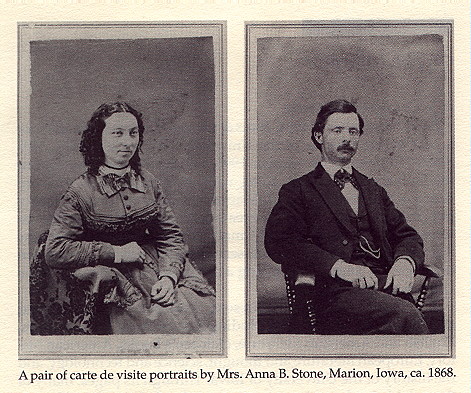
 "The woman who makes photography profitable must have, as to personal qualities, good common sense, unlimited patience to carry her through endless failures, equally unlimited tact, good taste, a quick eye, a talent for detail, and a genius for hard work. In addition, she needs training, experience, some capital, and a field to exploit." So wrote Frances Benjamin Johnston, then a successful Washington, DC, portrait and documentary photographer, in an 1897 Ladies Home Journal article entitled "What a Woman can do with a Camera." Clearly she wrote from experience and since, near the end of her life, she donated her photographs, negatives, and correspondence to the Library of Congress, much is now known about her remarkable career. [1]
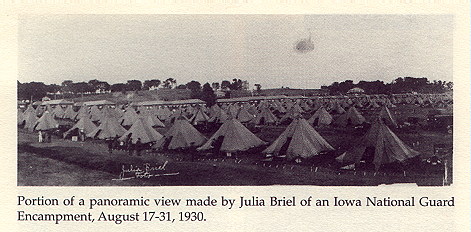
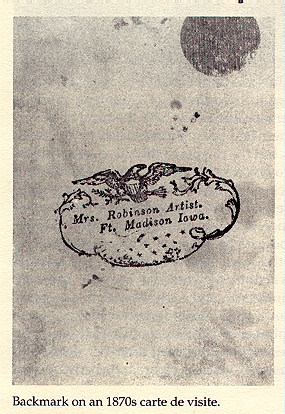
 By the time of her article, women photographers had been finding fields to exploit in Iowa for several decades, but the details of their lives and careers have not been recorded to any notable extent. An invaluable, but as yet unpublished, directory of Iowa's nineteenth century photographers being compiled by Jo Ann Burgess is the most extensive record now in existence. A slowly growing collection of original and copy images produced by women in Iowa, acquired by this writer, and now in the Iowa Women's Archives is another attempt to document this activity by women in the state. Most are portraits from the late nineteenth and early twentieth centuries, the greatest number from a single photographer being a large collection of panoramic photos by Julia Briel of Des Moines from the 1920s and 1930s. These were preserved after her death and eventually sold while extensive business records she had also kept were thrown away. The photos tell that she was called on to record the members of the state legislature, endless groups of conference-goers, college and school groups around the state, sewing machine factory workers in Illinois, nursing students in LaCrosse, Wisconsin, nuns in San Antonio, and much more, but we know little else about her. In some cases, a single photograph may provide all we know of a photographer such as the carte de visite portrait of a child, probably from the 1870s which has "Mrs. Robinson, Artist, Ft. Madison" printed on the back.
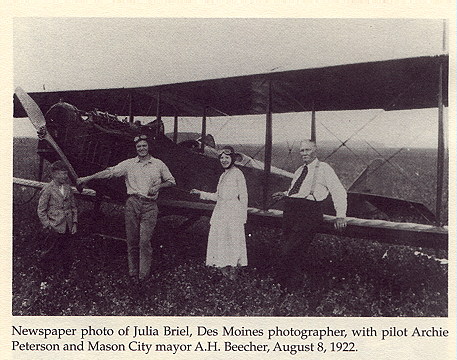
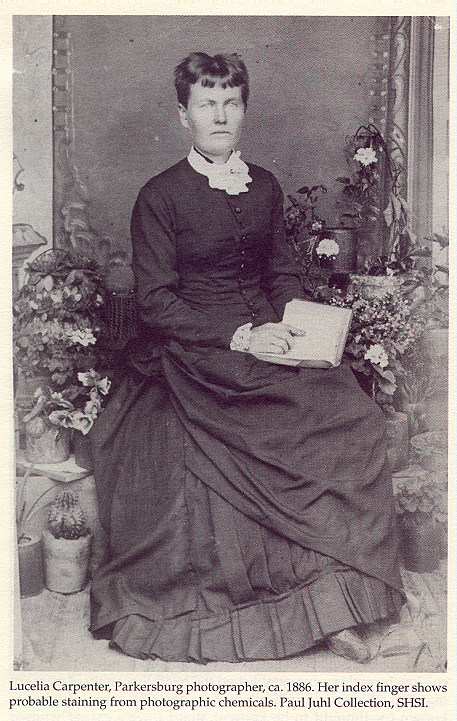 Also in the Iowa Women's Archives is a collection of materials relating to Helen Bamford (1902-1994), a studio photographer in Muscatine, which includes newspaper clippings, diaries, personal account books, albums of informal snapshots, and studio portraits -- thus far the most extensive documentation of an individual woman photographer of this type in the Archives. Having such resource material preserved is rare as are photographs of the photographers themselves. We do have a newspaper photograph taken of Julia Briel as she was about to take an airplane ride in Mason City in 1922. There is also a portrait of Lucelia Carpenter (active in Parkersburg from the mid 1880s) provided by her great niece along with the regrettable information that Lucelia's original glass plate negatives had been turned into window panes in a chicken house! Having established the relative scarcity of primary material, this article will attempt to describe some of what is known (or thought to be known) about Iowa's earlier women photographers with examples of their images from the Archives collection to illustrate the breadth of their productivity. [2]
 While professional photography was a predominantly male occupation from its start in the mid-nineteenth century, the number and proportion of female "securers of shadows" steadily increased, at least through 1920. Federal census data reveals the number of women professional photographers in the United States grew from 228 in 1870 to over 7000 in 1920. In Iowa there were only two photographers and seventy-four daguerreotypists (both men and women) counted in 1860. One of these may have been Nancy Thomas in Boonesboro, the only obviously female name from that date in J. Burgess's database. By 1880, 5.7 percent of the state's 420 photographers were women, one percent more than the nationwide figure. By 1920 in the U.S. the percentage of women in the occupation had grown to 20.7. More women took up the profession in the Midwest than was typically the case in the more urban East, and they were more likely to locate in smaller cities, towns, and villages. [3]
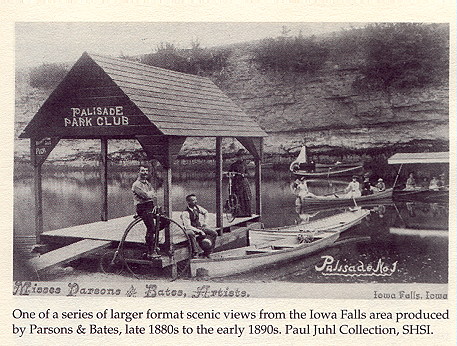
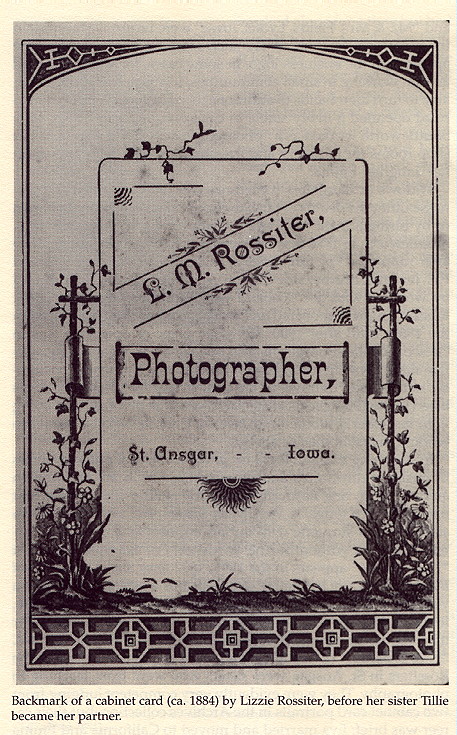 Though fewer in number, women's photographic careers were as varied in scope and quality of work as the men's. They worked in studios but some like Mrs. L.A. Schooley (mother of five and an Indianola photographer for many years from 1879) and Parsons & Bates (in Iowa Falls from 1889) also hauled their heavy equipment out into their communities and the countryside. Presumably, however, they were much less likely than men to follow the life of the solitary itinerant photographer with a "traveling photographic car" or tent. They usually acquired their training by working for established photographers -- the method recommended by Frances Benjamin Johnston, who pointed out that the few schools in existence in her day were in large cities and designed chiefly for amateurs. Lizzie Rossiter followed that route in the 1880s when she left primary school teaching and went to work for a photographer in St. Ansgar. When he moved on in a few years, she acquired the business, soon took in her sister Tillie as partner, and as "L.M. & T.E. Rossiter" they worked together in their second floor gallery over their residence for over forty years. Lizzie in turn also trained her two younger brothers and a series of young women, some of whom went on to operate their own galleries elsewhere or to work as retouchers for other photographers. Other sister-partners were the Woodwards in Burlington, the Marbles in Vinton, and the Gonwicks in Northwood. Partnerships of apparently unrelated women were Parsons & Bates (Stella and Hatta) in Iowa Falls and Tibbetts & Ernst in Cresco.
In many cases women worked in partnership, whether formally acknowledged or not, with their husbands. Although their names or initials didn't appear in the business stamp or imprint, Dora Rossiter worked with her husband Charles (Lizzie's brother) in Riceville, and Charlotte Cundill in Maquoketa partnered with her husband Will. "Mr. & Mrs. L.W Schoonover, Artists, Vinton, Iowa" and "Mr. & Mrs. Fields, Lyons, Iowa" were unusual examples in the nineteenth century where such working relationships were apparent in the business logo. In some cases, for women as well as men working in small communities, it was necessary or desirable to turn their hands to additional occupations. While her husband operated a livery stable in Cresco in the early 1870s, Mrs. Shuttleworth worked as a "photograph artist" and also used her shop rooms for millinery and dressmaking with assistance from her daughter Emma.
Widows or daughters sometimes carried on established businesses after the deaths of husbands or fathers, either on their own or by hiring a male "operator". Competing in Cresco with Mrs. Shuttleworth in 1870 was E.C. Jewett, who was continuing alone after running a "picture gallery" in the 1860's with her husband F.H. Jewett in nearby New Oregon. Another who may have started by working with her husband was Katie Russell whose "Mrs. Russell" imprint appeared on Cresco and Elma photographs from the 1880s until after 1900. Her chief place of operation was in Cresco, but she sporadically also opened a branch about twentyfive miles away in the village of Elma to reach potential customers not inclined to travel to the county seat for photos. She was listed in the 1900 census at age forty-seven as divorced and living with her elderly mother and her son Charlie, who by then also worked in his mother's galleries.
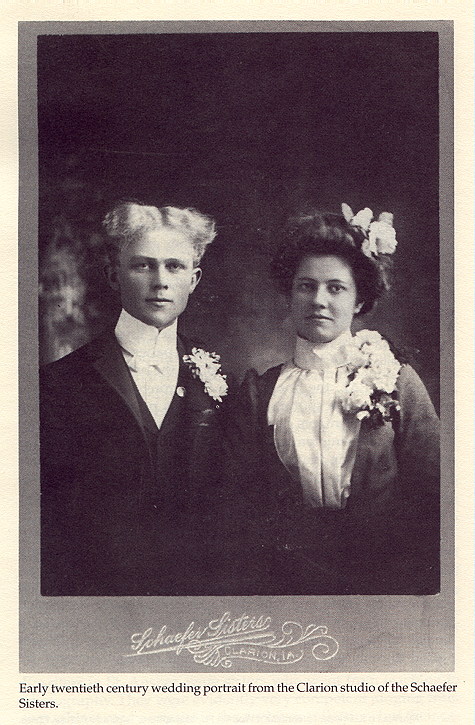
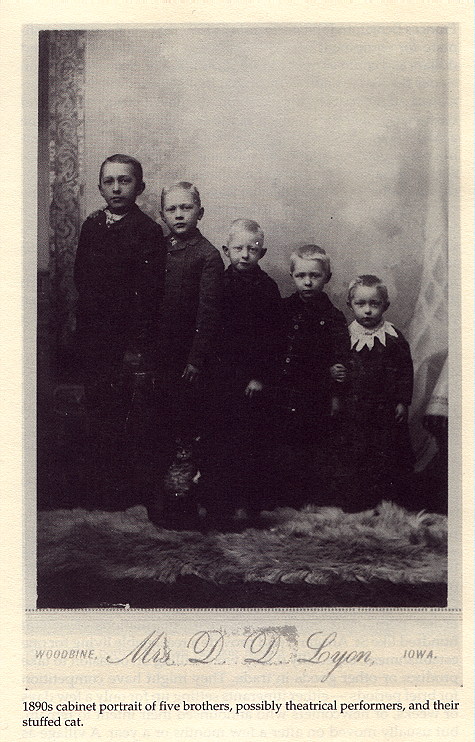
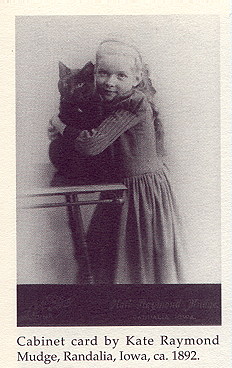 In searching through logos on photos or lists of photographers in business directories and other sources to locate the women among them, one naturally looks for gender-identifying first names or such terms as Mrs., Miss, Sisters, etc., but when only a surname or a surname with initials appears, one cannot be certain of gender without further evidence. For example, a modest "K.R. Mudge" appears in the 1891/1892 Iowa State Gazetteer and Business Directory listing for Randalia, but a cabinet portrait of a young girl with her cat has "Kate Raymond Mudge, Randalia, Iowa" boldly spelled out on the card mount. It was common for men but not unusual for women to use their forename initials. "E. & E. Benfer" (Eva and Emma) in Cambridge in 1900, like the Rossiters in St. Ansgar, were sisters who went from teaching to photography. They were evidently very competent judging from two cabinet card portraits in the Archives collection, but their career was brief; Eva married and moved to California and Emma worked alone for a time but had moved to Los Angeles by 1905. It has been suggested that those using initials wished to conceal their gender to avoid discrimination from potential clients, but this seems unlikely since, in most cases, they would have been well known in their small communities. Also, the majority of their customers were probably women or couples, families, and other groups including females who might have felt more at ease going to an establishment where a woman was present. In fact, women customers were often targeted through notices in the local papers urging mothers to bring the baby in between 10 A.M. and 2 P.M., the hours when the strongest available light would have made shorter exposure times possible and coping with squirming infants or fidgety small children easier. Further evidence that being female was not a disadvantage and possibly an advantage is in the quantity of partnerships and individuals where this was made clear on their mounts or advertisements: "Schaeffer Sisters" in Clarion; "Misses Parsons & Bates, Artists" in Iowa Falls; "Mrs. H.P. Harvey" in Maquoketa; "Miss L.E. Pomeroy" in Independence; and "Mida Hall," "Mrs. D.D. Lyon," and "Lillian Jefferson," all at various times in Woodbine, and many others.
Questions arise as to why there were not more women in the photographic ranks and why the careers of so many were brief. As noted in an article on women photographers in Nebraska, a barrier for many women would have been the lack of sufficient capital to rent, buy, or build a studio and adequately equip it. [4]
Frances Benjamin Johnston wrote in 1897 that a conservative estimate for equipment would be between one and two thousand dollars and could easily be more. A building or rooms (often in an upper floor over another business) that included pleasantly furnished public space(s) for reception, display of photographs, and customer preparation as well as the area with skylight(s) for the actual posing for photographs, private areas for developing, printing and mounting of photographs and storage of negatives, plus all the associated equipment and supplies, would require substantial outlay. For those like the Rossiters in St. Ansgar, who succeeded initially (perhaps with help from their farmer father) there would be continuing need to update their establishments as fashions changed, better equipment came on the market, or competitors came to town promising quality work in the latest styles for lower prices. They could keep current through periodicals such as Wilson's Photographic Magazine and membership in professional photographers associations at whose annual meetings in Des Moines or Minneapolis new products and processes were demonstrated and members could submit their work for exhibition and competitive judging. If these small town operators succeeded long term, it was through wise use of advertising, building solid reputations that attracted customers from nearby communities as well as their own, and providing related merchandise and services. Typically offered were photograph copying, coloring and enlarging, picture frames, albums, and, as cameras and roll film for amateurs became available, they would sell those and do the developing and printing.
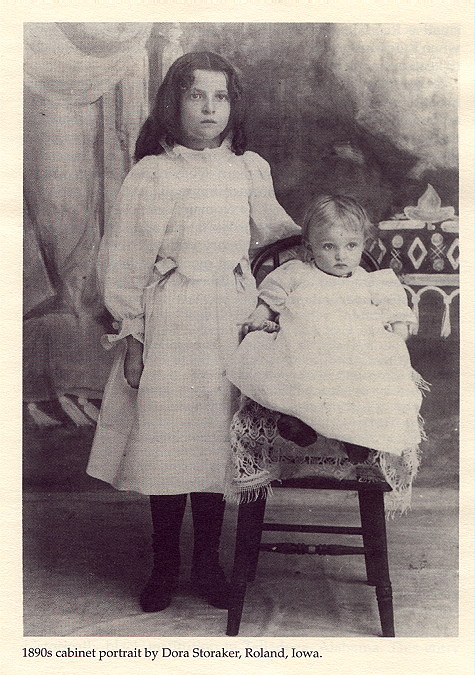
 As for the brevity of many careers, that was the case with the men as well, and the reasons were probably as varied as the individuals and situations involved. Some women left to marry and become homemakers, others moved on to more congenial work or more potentially exploitable locations. County seat towns like Cresco could typically have two or three galleries that were more or less permanent. Smaller towns with populations of several hundred like St. Ansgar could provide a reasonable living for one establishment, especially if they were willing on occasion to take produce or other goods in trade. They might have competition for brief periods -- either itinerants setting up for only a few days or weeks, or newcomers who announced their intent to remain, but usually moved on after a few months or a year. A village as small as Randalia (fewer than two hundred persons in the 1890s when Kate Mudge worked there) would have been very unlikely to keep even one for very long.
By the 1920s, as amateur photography became ever more popular, and paved roads made it easier for families to drive their new automobiles to larger cities for business and shopping, the smaller towns' studio photographers were usually not being replaced as they moved, retired, or died. Still, photography has remained a viable occupational choice for many women in a country where, as Frances Benjamin Johnston encouragingly (and optimistically, perhaps, for 1897) concluded, "a woman needs only the courage to enter any profession suitable to her talents and within her powers of accomplishment." Our history will be enriched as more comes to be learned of the women mentioned here and Iowa's many other talented and accomplished women photographers, both professional and amateur.
NOTES:
[1] Pete Daniel and Raymond Smock, A Talent for Detail: the Photographs of Miss Frances Benjamin Johnston, 1889-1910 (New York: Harmony Books, 1974), p. 34.
[2] Much of this article is based on information gathered from federal and state census records, county histories, the Iowa State Gazetteer and Business Directory, and weekly newspapers preserved on microfilm at the State Historical Society of Iowa -- chiefly those from Cresco, New Oregon, Osage, St. Ansgar, Riceville, and Cambridge, Iowa. Access to a listing of the photographers in Jo Ann Burgess's database of nineteenth century Iowa photographers was also a vital source for photographer's names with their places and dates of activity. Additional information and photographs were supplied by Paul Juhl and Barb Stahl.
[3] William C. Darrah, "Nineteenth Century Women Photographers," in Shadow and Substance: Essays on the History of Photography in Honor of Heinz K. Henisch, ed. K. Collins, (Bloomfield Hills, MI.: Amorphous Institute Press, 1990), pp. 89-703.
[4] Martha H. Kennedy, "Nebraska's Women Photographers," Nebraska history, 72, no. 2 (Summer 1991).
-End-