The University of Iowa Libraries
Special Collections and University Archives

Finding Aid
|
Papers of John V. McMillin II Access and Restrictions: This collection is open for research. Digital Surrogates: Except where indicated, this document describes but does not reproduce the actual text, images and objects which make up this collection. Materials are available only in the Special Collections Department. Copyright: Please read The University of Iowa Libraries' statement on Property Rights, Copyright Law, and Permissions to Use Unpublished Materials. Use of Collections: The University of Iowa Libraries supports access to the materials, published and unpublished, in its collections. Nonetheless, access to some items may be restricted by their fragile condition or by contractual agreement with donors, and it may not be possible at all times to provide appropriate machinery for reading, viewing or accessing non-paper-based materials. Please read our Use of Manuscripts Statement. Acquisition and Processing Information: The Papers of John V. McMillin II were donated to the University of Iowa Archives in three accessions during 2006 and 2007. Finding aid posted to the Internet April 2007. Photographs: Box 2, Folder 4 |
|
Scope and Contents
The Papers of John V. McMillin II primarily chronicle developments at the Measurement Research Center (MRC), which was founded in 1952 by Prof. Everett F. Lindquist of the University of Iowa College of Education. Prof. Lindquist pioneered the design and use of standardized tests in American public schools, beginning in the late 1920's. By 1953, he and his staff developed an optical mark reader (OMR) for scoring students' test answer sheets. The "electronic brain," as the OMR was called at the time, was a breakthrough in providing, for the first time, large-scale high-speed test scoring. However, its vacuum-tube technology was becoming obsolete, and by 1959 MRC began work on the design and development of solid-state, or transistorized, circuitry to replace the less stable vacuum tubes.
The bulk of the papers document activities at the MRC from 1959 to about 1980 from the perspective of a project engineer, and later engineering manager, who was closely involved with assignments leading to the expanded use of standardized tests and test scoring, electronic balloting, and other applications of scan-related technologies. Development of the American College Testing program, a project of the MRC, is included. The papers also offer a glimpse into the corporate culture of Westinghouse Corporation, which acquired MRC in 1968 as Westinghouse Learning Corporation (WLC). WLC was, in turn, acquired by National Computer Systems in 1983. Later, in 2000, it was acquired by NCS Pearson and became Pearson Educational Measurement in 2002. Documents in this collection pertain mainly to the MRC-WLC era.
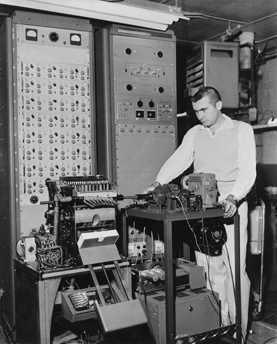
Items of interest include a 1952 proposal for an electronic high-speed test-scoring machine, accompanied by notes by Prof. Lindquist (Box 2, Folder 1); correspondence concerning patent filings; and technical and project reports. In addition to documents, the collection includes several artifacts that represent the state of technology at the time of their design and manufacture, including an early-1960's era computer memory module with a capacity of less than 1 kilobyte. Photographs depicting early automated test-scoring apparatus of the 1950's and 1960's located in the basement of East Hall (later renamed Seashore Hall) are in Box 2, Folder 4.
The collection is organized into four series: Series I and II, which reflect two accessions of documents prepared by Mr. McMillin; Series III, which consists of collection inventory and supporting information, digital surrogate copies of items in this collection, and donor's commentaries; and Series IV, consisting of artifacts. Materials in Series II are generally arranged in chronological order. Many of the folder titles in Series II (e.g., "1953_11_03_SUI" in Box 2, Folder 2) reflect their matching digital file titles on DVD.
Biographical Note
John V. McMillin II was born in 1934 in Wapello County, Iowa, and graduated from Bloomfield (Iowa) High School in 1952. On June 12, 1955, he married Lois G. Cossel of rural Bloomfield at her family's home; they had three sons. He graduated from the State University of Iowa in 1957, receiving the Bachelor of Science degree in electrical engineering with high distinction honors. While a student in 1956 and 1957 he was employed at the Measurement Research Center (MRC) as a part-time engineer.
His professional career began in March 1957 as a field engineer with Sandia Laboratories, Albuquerque, NM. Sandia, a unit of the Bell Telephone System, was a sub-contractor with the Atomic Energy Commission. In March 1959 Mr. McMillin returned to Iowa City to accept the position of Project Engineer at MRC. Following the acquisition of MRC by the Westinghouse Learning Corporation in June 1968 he was appointed WLC/MRC Engineering Manager, a position he held until 1978. From then until 1980 he was a consultant to WLC, National Computer Systems (NCS), and other companies, and in June 1980 began full-time employment with NCS in the engineering department. When NCS acquired WLC in November 1983, he was named Engineering Manager of its Iowa City operation. He retired in 1996.
Mr. McMillin received the Westinghouse Patent Award in 1972 for five inventions granted U.S. patents. Early in his career, between 1960 and 1963, he also published several journal articles pertaining to technical and electronic design. An avid conservationist, he has maintained native prairie grasses, wildlife wetlands, and maturing trees on his family's 340 acre farm in Davis County, Iowa.
[D. McCartney, 4/2007]
Related Materials
Folder, "McMillin, John V., II", Faculty and Staff Vertical Files collection (RG 01.15.03)
Lindquist, E.F. "The Iowa Testing Programs--A Retrospective View." Education 91 (September-October 1970): 4, 6-23, illus.
Lindquist, E.F. "Oral History Interview." University of Iowa Oral History Project, 22. 38 pp. 1976.
Papers of E.F. Lindquist (RG 99.0227)
Peterson, Julia J. "The Iowa Testing Programs: The First Fifty Years." Iowa City: University of Iowa Press, 1983.
Box Contents List
Note: Folder descriptions and annotations below were provided by John V. McMillin II in 2006 and 2007. Seven DVD discs, containing digitized copies of many of the documents described below, are provided as part of the collection in Series III and are referenced in the annotations. The discs are in Box 5, Folders 8 and 9.
Frequently-used abbreviations below include JVM (John V. McMillin II), MRC (Measurement Research Center), WLC (Westinghouse Learning Corporation), NCS (National Computer Systems), and OMR (optical mark reader).
Series I: Accession 1
Box 1:
1. E. F. Lindquist U. S. Patent No. 3485489, granted 23 December 1969 – original Blue Ribbon copy
DOCUMENT FEEDING MECHANISM2. E. F. Lindquist U. S. Patent No. 3506258, granted 14 April 1970 – original Blue Ribbon copy
DOCUMENT FEEDING MECHANISM3. Seven U. S. Patents searched by Lindquist’s Patent Attorney for reference purposes in applying for his first U. S. Patent: dates range from 6 AUG 1935 to 18 SEP 1945
4. E. F. Lindquist Letter dated 12 APRIL 1965 to Patent Attorney Andrew Beveridge requesting a prior-art search and possible filing for a U. S. Patent on a Document Feeding Mechanism Lindquist has invented. Letter includes 3 pages of hand-drawn sketches by Lindquist, and witnessed and signed by Chief Engineer Robert A. Edberg, and Engineer Tom Jacob. [documents related to No. 1 above]
5. E. F. Lindquist Letter 2-page letter dated 11 NOV 1965 to Andrew Beveridge requesting a prior-art search for an MRC Colored-Ink Detection System (invented by John V. McMillin).
6. Original bound copy of preliminary report for Colored-Ink Detection system prepared by John V. McMillin, R/D Dept., dated 10/22/65. Five typewritten pages, one JVM hand-drawn sketch page, and copy of E. F. Lindquist Letter No. 5 above. [JVM Note: This basic concept eventually led to a more complex U. S. Patent many years later by John V. McMillin: 5,103,490, granted 7 APRIL 1992.]
7. MRC Intellectual Property MEMO, dated 1/8/68, to D. P. Wahl from Edberg: describes the sole U. S. Patent granted at that time (E. F. Lindquist), and a list of nine patents pending, six technical disclosures, and seven Technical Development categories and ‘know how’. Many of the items listed led to U. S. Patents being granted in future years.
8. Two copies of E. F. Lindquist U. S. Patent METHODS AND APPARUTUS FOR PROCESSING DATA, filed 21 SEP 1955, granted 21 AUG 1962, 29 claims, 22 sheets of drawings, 26 text pages.
9. John V. McMillin U. S. Patent File Folder: fourteen (14) patents total, eight (8) sole inventor, six (5) as co-inventor or lead inventor, one (1) shared with two other inventors. Issue dates range from 23 DEC 1969 to 2 FEB 1993.
10. Original Folder: “SCAN HEAD SYSTEM for Sensing Marks and/or Punches from Cards: MRC Model 1501 Card/OMR Reader” B.S. & B file 15,318. Contains JVM’s original 46-page Technical Disclosure, dated 3/12/66, [MRC R/D Dept.], ten technical drawings, Edberg to/from Beveridge Correspondence file (Chief Engineer to MRC Patent Attorney), and related documents. Project Engineer John V. McMillin was granted U. S. Patent No. 3,566,083 on 23 FEB 1971, based upon this invention, and at the time when the IBM punched-card ‘reigned supreme’ in data-processing, the MRC innovation in combined punched-hole/OMR scanning was the ‘cutting edge’ in accuracy and speed.
11. TECHNICAL DISCLOSURE on COLUMN SYNCHRONIZATION METHOD for OPTICALLY SCANNED DOCUMENTS, dated 31 OCT 1966, developed by the MRC Product Development Dept., authored by John V. McMillin, Manager. This 30-page document, plus APPENDICES with drawings, tables, charts, and related information, describes an early use of solid-state technology and related mechanisms to solve a timing issue with the high speed combined OMR/punched-hole reading of IBM ‘tab card’ documents on specially designed MRC scanners.
12. MRC Technical Report, dated 4/25/1961: TENTATIVE SPECIFICATIONS FOR MRC SCORING MACHINE TAPE OUTPUT SYSTEM, 4-page report, plus tables, block-diagram, authored by JVM, and trip report to DI/AN Controls vendor. By the early 1960’s, magnetic tape systems were becoming available to replace/supplement the ubiquitous punched-hole IBM tab-cards for storage. Accordingly, MRC began plans to store the scanned OMR sheet output data onto magnetic tape. This brief technical report outlines the requirements, steps, procedures, and includes a JVM Trip Report summarizing several possible vendors to assist MRC in accomplishing this objective. Authored by JVM. In due course, MRC did indeed convert to magnetic tape storage systems, rather than cards.13. E. F. Lindquist MEMORANDUM to Bob Edberg (Chief Engineer), dated 29 JUL 1965, describing his latest developments in High Speed Precision Sheet Feeder for Mod 9 (scoring machine): Includes 4 hand-drawn sketches, by Lindquist, initialed and dated 27 JUL 1065. His memo copied to John McMillin (Project Engineer), Tom Jacob (MRC engineer), and Pete Wahl (General Manager). A rare document that exhibits Dr. Lindquist’s creative mechanical-design abilities and draftsmanship!
14. E. F. Lindquist’s document, MULTIPLE SENSING AND SWITCHABLE ENCODING IN OPTICAL SCANNERS, “An Invention by E. F. Lindquist”, dated 2 AUG 1965: yet another example of Dr. Lindquist’s passion for clever inventions and being deeply involved in the ‘early days’ of MRC Engineering development and design of OMR scanners. True, we on the MRC engineering staff sometimes regarded Lin’s ideas as a bit on the Rube Goldberg side of the aisle, and as I recall, this was one of them, and we never implemented this particular idea of his, nor did he apply for a patent. However, this original Lindquist paper does describe a basic and fundamental problem – with respect to document registration – in the accurate scanning of position-encoded OMR marks therein, and fortunately, the problem was solved more than a decade later when CCD arrays became commercially available. Refer to McMillin/Schroeder U. S. Patent No. 4,300,123, issued 10 NOV 1981.
15. LAMENT OF THE BUBBLER: a doggerel by Buz Spooner, Principal, Greenacres Elementary: not everyone, in fact most students, did not enjoy ‘filling in the answer-bubbles’ on the Lindquist Iowa Tests of Basic Skills battery of tests. Apparently, Mr. Spooner sensed this frustration amongst his students, and wrote this witty and humorous poem. Although the enclosed copy is not dates, I believe it began to circulate in the 1960’s, and no doubt has withstood the test of time!
16. PARALLEL BIT PARITY GENERATOR USING MRC NOR-OR CIRCUITRY: A 6-page Technical Disclosure, plus 2-page Appendix, and thirteen (13) hand-drawn circuit/logic diagrams.
Parity-checking is a paradigm in logic/data-processing circuitry to represent the odd or even count of the eight (8) “0 or 1” data bits, for example, of an 8-bit byte. A ninth bit – the parity bit – is a “1” if the “1” count within the 8-bit byte is ‘odd’, or is a “0” if the “1” bit count is even. This is known as an “odd” parity-bit generator; an even-bit parity generator would output a “0” bit for this example. This disclosure, authored by JVM, describes a general-case solution for a “2 to N bit-wide” word, employing MRC NOR-OR transistorized logic circuits. Developed in the early 1960’s, long before integrated circuits were commonly available, this logic would fit in a tiny corner of an IC chip today.
17. A Preliminary Report on SCORING MACHINE PROPOSAL for the NATIONAL LEAGUE FOR NURSING (NLN), prepared by Measurement Research Center, Engineering Division, Iowa City, Iowa, dated December 19, 1961: Dr. Lindquist was approached by this organization earlier in 1961 about the feasibility of MRC designing and building a special OMR-card scoring machine for the League’s various tests administered to nursing students. As Technical Project Manager of the MRC Engineering Division, I was assigned the task of drafting a Technical Proposal for their consideration. This 20-page report, plus Appendix, describes the proposed features and performance of such a system. For reasons long forgotten the project never reached fruition, but this document illustrates Dr. Lindquist’s desire to ‘take on’ any reasonable customer for fame and gain! The NLN organization thrives yet today; see URL: http://www.nln.org/18. JVM/MRC Folder: This folder presents my “MRC Discrimination System for Mark-Sense Scanning, a Technical Disclosure”, dated 11 FEB 1966, and eventually leading to two (2) U. S. Patents, granted more than three years after the initial filing date of 6 APRIL 1966, in that the first patent was granted 23 DEC 1969, and the second one granted on 11 AUG 1970. These were the first two of my 14 patents granted during my career with MRC, WLC, and NCS from 1956 to 1996. Prior to this invention, the original 1950’s circa MRC Scoring machines had certain weaknesses or limitations in the vacuum-tube design of that era to accurately discriminate between a student’s intended, darker mark, and an overly smudgy erasure, leading to scoring errors; or failing to detect an intended ‘cheat’ double/multiple mark, and giving false credit to the student’s answer. This invention, incorporating transistorized circuits and an entirely new approach to the solution, essentially eliminated this difficulty, and greatly increased the accuracy (and confidence!) of/in the scored results. Also included in this folder is the lengthy correspondence trail between MRC and our Patent Counsel located in Washington, D.C. Any aspiring inventor who wishes to file for a U. S. Patent on his/her invention should peruse these letters and related documents to realize that the path from idea to a granted U. S. patent can be long and rocky! And, very very expensive today! Lawyers don’t work for peanuts! Dr. Lindquist’s first U. S. Patent on his original scoring machine also took a long time.
19. OUTPUT STACKER for HIGH SPEED DOCUMENT CARRIERS: Dated 30 January 1967. Inventor: E. F. LINDQUIST. This 11-page Technical Disclosure is ‘classic Lindquistian’ in terms of elaborate mechanical components, such as springs, rollers, plates, plastic sheets, foam rubber, and related apparatus. The Disclosure includes four original 11” x 17” Figures/Drawings, signed by RAE (Robert A. Edberg, Chief Engineer at MRC), and dated from 28 to 31 JAN 67. The descriptive Figures were probably drafted/drawn by Edberg, as they are rather ‘too neat’ with respect to Lindquist’s more informal/cryptic style of sketches normally seen with his Technical Disclosures. My copy of this Lindquist Technical Disclosure contains a cover letter written by Edberg to the MRC Patent Attorney, Mr. Andrew B. Beveridge, dated February 1, 1967, requesting a review of the attached material for patentability (e.g. conduct a prior-art patent search, etc.). Curiously, however, the Edberg letter states that “This will be a personal patent by E. F. Lindquist and consequently you will bill him directly for the work involved.” Furthermore, in Edberg’s handwriting on the top of the letter is the notation “Not mailed at EFL’s request – Edberg”, so Lindquist must have had second thoughts. I was not directly involved in this ‘elaborate Lindquistian’ design to effect a gentle deceleration of the scanned sheets as they were driven into the output stacker at high speeds, so I can only speculate that possibly Lindquist saw a potential opportunity to profit from owning the anticipated U. S. Patent himself, and to license the idea to other companies who had similar problems with gently stopping sheets of paper moving at high velocities. Regardless, we did not incorporate this complex design into our MRC high-speed OMR scanners of this era, but solved the deceleration by more simple means.
20. MRC 1501 SCANNER PROJECT: A Review of the “Intellectual Property” which existed on or before October 16, 1966, and including relevant comments on progress from 24 November 1965 to the current date: Prepared by the MRC PRODUCT DEVELOPMENT GROUP, Engineering Division
Iowa City, Iowa, John V. McMillin, Manager, April 7, 1967. Previous Item in this list of UI Accession documents described the technology and issued U. S. Patent related to the MRC 1501 scanner. However, there is a lot more to the story in relation to MRC (as a not-for-profit entity) attempting to forge a design/manufacturing relationship with a major industrial corporation, LITTON Industries, and the LITTON managers who resigned from LITTON to form a new company, IKM Industries, to carry on the development task with MRC. This review of “Intellectual Property”, authored by me, was the first step in preparing for litigation and/or settlement of the MRC financial obligations when the MRC-LITTON-IKM relationships were terminated.21. Des Moines Register Article clipping (Original Copy), published January 9, 1972: “Educational Assessment Services Supply Major Iowa City Industry”. Includes a photo of the ACT headquarters, a photo of E. F. Lindquist, and mentions “An optical card scanner developed by the MRC staff can process 90,000 cards an hour”. This refers to the above MRC 1501 Card reader, referred to elsewhere in this list. The article contains a brief history of ACT and MRC, among other information.
22. Everett F. Lindquist & George E. Carsner U. S. Patent, No. 3,578,159, DOCUMENT HANDLING APPARATUS, granted on 11 MAY 1971. This important patent covered a hardware/software method to offset a given sheet in the output stack after scanning, so that the sheet could be quickly accessed by human editing clerks for error resolution. USPO Downloaded copy is provided, both the transcribed text and claims, and the images.
23. USPO Download copies of Everet F. Lindquist Patents No. 4, 130,283, issued 19 DEC 1978, SIMULATED FAIRWAY SURFACE FOR GOLF APPARATUS, and No. 4,177,994, issued 11 Dec, 1979, GOLF GAME AND PRACTICE APPARATUS: Dr. Lindquist’s obvious passion for inventions did not cease following his retirement from the presidency of MRC after it was acquired by WLC in 1968. Many people familiar with the Lindquist Center on the UI Campus would probably be quite surprised to learn that he was granted two U. S. patents related to the game of golf! The Assignee in both of these patents was the University of Iowa Research Foundation, Iowa City, IA. In the later patent named above, filed on December 20, 1976, he needed assistance in the design of the electronic and logic circuitry components embodied in this invention. He approached me to request help, but as I was very busy with leading WLC’s entry into the Ballot Scanning Business at this juncture, I recommended that he hire one of my highly skilled technicians, Dale Schroeder, to assist him on a ‘moonlighting’ basis. He followed my suggestion, and as the patent text and drawings clearly show, he submitted a successful application.
24. Westinghouse Subsidiary Will Purchase MRC Here: Announced in the Iowa City PRESS-CITIZEN on Friday, June 28, 1968. My 4-page document includes a copy of the original newspaper clipping containing several photos, and a transcription of the announcement’s text.
25. “The World of MRC Engineering in 1968”, A Glimpse at the Past, a Review of the Present, and a Peek at the Future [Prepared by JVM for a Presentation to WLC Senior Management in New York City in 1968] Shortly, thereafter, several of us were invited to WLC’s corporate headquarters at 100 Park Avenue in New York City, NY to give individual presentations on our respective areas of responsibility at MRC. As Engineering Product Manager, it was my job to tell the “Engineering Story.”
26. 1969 FALL MRC-ENGINEERING REPORT, John V. McMillin, Manager:
A 2-page status summary through the first 3-quarters of 1969.27. MRC ENGINEERING AREA ACCOMPLISHMENTS DURING 1969, John V. McMillin, Manager: A 6-page document that presents an overview of projects and related activities in 1969. Among other projects, we were designing and building a special high-speed OMR scanner, Model 650-E, for a customer in London, England, and also testing a radically new OMR scanner design dubbed RASCOL for internal use and sale to domestic and foreign customers.
28. 1970 FALL MESSAGE, Engineering Department - by John McMillin: It became a ritual in the fall of each year, following the acquisition of MRC by WLC in the summer of 1968, for the MRC Managers in Iowa City to prepare their respective ‘Fall Message’ to present to the troops and presumably, to be forwarded to WLC Headquarters for their scrutiny of our progress and accomplishments. My 6-page 1970 Fall Message shows that the Model 650-E was delivered by me to Document Reader Services Ltd., in London, and we were also busy designing special card readers to deploy in WLC ‘Mini Centers’ in Boston, NYC, Quebec City, Quebec, and other possible locations. The RASCOL scanner design was nearing completion, later defined as the W-301, and a substantial number were subsequently installed in the U. S. and Japan.
29. SUMMARY of 1971 Accomplishments and 1972 Objectives: WLC/IC Engineering Department, John V. McMillin, Manager: Similar in scope to the above 1970 report, this is another summary of the Engineering activity during 1971, and what we hoped to accomplish in the year ahead. My 10-page report mentions that we installed WLC Mini Center scanner hardware in Lake Washington, WA, and Milford, CT, and were providing Engineering/technical support for five Mini Centers. We completed the RASCOL/W-301 OMR Scanner design, and were building ‘turn key’ OMR systems for Educational Testing Service in Princeton, NJ. Six U. S. Patents were awarded during 1971.
30. 1972 Objectives for the WLC Engineering Department: This 4-page report is essentially a continuation of the preceding 10-page 1971 Engineering Report, which were submitted together. JVM NOTE: I have copies of my two lengthy and rather personal handwritten 1974 and 1975 year-end Engineering reports, as submitted to my boss, Burdette P. Hansen, WLC/Iowa City General Manager, but they are too difficult to read to be of any interest to a future MRC/WLC history researcher. Perhaps someday for my own amusement I will transcribe the text, perhaps not. The 1974 report includes an organizational chart for the Engineering Department, and shows a year-end head count of 29 staff, with an annual salary cost of slightly under $300,000! Amazing in terms of today’s dollars…
31. SUMMARY of 1972 Accomplishments and 1973 Objectives: WLC/IC Engineering Department, John V. McMillin, Manager: Similar in scope to the1971 report, this is a summary of the Engineering accomplishments during 1972, and what we hoped to accomplish in the year ahead. A 70+ page bound folder, including goals and objectives for each Engineering-Dept. supervisor.
32. Westinghouse gets $29 Million Contract: Iowa City PRESS-CITIZEN Front-Page Headline on Thursday, June 30, 1983. My archival copy is the original newspaper containing the front-page, and 5 additional pages. The article about WLC refers to the Iowa City Division winning this contract from the U. S. Department of Education.
33. New MRC/WLC Building Folder: Seventeen Press-Citizen news clippings about the plans, and zoning disputes and controversy, in WLC’s announcement to build a new $4 million Facility on annexed farmland west of the ACT building. Nearly all of the clips are from the original newsprint, and all but a couple are precisely dated, ranging from October 29, 1969 to April 9, 1971. I was privileged to have a choice office location with a nice window in this facility – which were few and far between in the new design!
34. WLC “RASCOL” Business Plan: Other JVM Archival documents and reports describe an entirely new concept in OMR scanner design whereby both sides of an answer sheet can be scanned independently on a single pass through the feed mechanism, which I dubbed with the acronym Reverse Action Scan Cycle On/Off Line (RASCOL). Our ‘little rascol’, as we humorously called it! Brief background: when one of my mechanical engineers, Richard W. George first (cautiously or tentatively) proposed the idea to me, probably thinking I would reject his ‘wild idea’ out of hand, I instead encouraged him to build a simple prototype mechanism in our machine shop in an attempt to demonstrate the feasibility of the concept. Encouraged by what we observed, I authorized a full-blown development cycle. Mr. George was granted a U. S. Patent on the design. Our first victory in this regard was demonstrating the shop mockup to a group of officials from Educational Testing Service (ETS), the major student testing organization from Princeton, NJ. (ETS administers the College Board and GRE exams, among many other tests). They were so impressed with the demonstration and anticipated performance of the product that they delayed, or ‘put on hold’ a nearly final decision to purchase one or more OMR scanners from National Computer Systems (NCS), or archrival at the time! Instead we jointly scheduled several future benchmarks on the new design, and we landed a large order (several hundred thousand dollars) for the delivery of a turnkey OMR processing system based upon the RASCOL design. Eventually, this product was sold to other customers in Australia, Japan, as well as deployed at locations in the U. S. A re-engineered lower-cost version, the W-201 Model was sold in quantity in Japan, Korea, and other countries, and widely used in domestic locations. Although the acquisition of MRC by Westinghouse Learning Corporation (WLC) was not formally announced to the public until June 28, 1968, the two company’s management discussions, analyses, planning, and future business strategies for a new WLC/MRC entity had obviously preceded this date for quite some time. One aspect of these discussions was the potential to manufacture on a significant scale the new MRC RASCOL scanner design. D. Peter Wahl was the General Manager of MRC, and a ‘prime mover’ in the MCR decision to be acquired by WLC, coincident with Dr. Lindquist’s retirement as President of MRC. Accordingly, he submitted (per WLC request) a RASCOL Business Plan to Mr. George H. Mathiesen, General Executive, of WLC, the cover letter of the PLAN-folder dated April 2, 1968. The contents cover the key categories of 1) Cash Flow, 2) Marketing Study, and 3) Engineering. I was responsible for preparing the Engineering portion of the plan, resulting in a 26-page Design Goals Report, with an approximate equal number of pages of internal memos, cost analyses and projections. The dates range from February 6, 1968 through September 6, 1968. The ‘mass manufacturing’ goals, naively envisioned by WLC, were not realized, as they failed to understand that this type of capital-intensive product was suitable only for a niche’ market; such as for academic institutions, or educational testing organizations similar to MRC, but we did sell – as I recall over forty years later – several dozen in U. S. applications, and others in Asia. Incidentally, WLC had me running around to Westinghouse Puerto Rico printed-circuit manufacturing plants and other installations to take ‘synergistic’ advantage of their mass manufacturing facilities!
In summary: I believe this is an important historical document in the early history of the WLC acquisition, as it clearly illustrates the shift in strategy from a local non-profit testing organization (e.g., MRC; under the aegis of the University of Iowa) which offered its testing services to academic entities, to a corollary WLC emphasis on designing, manufacturing, and marketing ‘state-of-the-art’ OMR Scanners for a World-wide market – with a profit goal!
35. AUTOMATIC CONTINUITY TEST DEVICE: Design Proposal by John V. McMillin, dated August 30, 1961, presented to Mason & Hanger – Silas Mason Co., Iowa Ordnance Plant, Burlington, IA. A ‘moonlighting project’ for a noble purpose by MRC employees. Background: This Iowa-based company, in business yet today, is a major producer of artillery shells and other ordnance for the Armed Services. Back in the early 1960’s, they were producing a variety of artillery shells employing the M509 fuse (which sets off the shell). Naturally, every shell coming off of the production line needed to be tested for proper function. Unfortunately, however, at that time the very act of testing each shell occasionally caused the shell to explode (electrical transients generated during the test measurement, etc.), the powerful blast lifting the roof off of the assembly building (a special non-anchored design for this contingency), and maiming or killing workers. In desperation, the executives of the plant approached Robert A. Edberg, Chief Engineer, to see if MRC could design a far safer testing system, based upon new solid-state technology, assuming that MRC had expertise and capability in what was then a new technology. While Dr. Lindquist was reluctantly supportive of MRC’s occasional assistance to U of I projects, such as making printed circuit cards in our MRC North Linn St. facility for professor Van Allen’s early satellites that led to the discovery of the (Van Allen) radiation belts, and as another example, manufacturing double-barreled hypodermic needles for the medical college to insert into the skulls of ‘happy, smiling laboratory rats’ (as Edberg coined the effort), or designing a 100,000 RPM centrifuge drilling bit (less painful!) for the Dental College, Lindquist was adamantly opposed to MRC getting involved with an Armed Services contractor making explosive devices. Yet, Edberg relished this challenge as posed by Mason & Hanger to his MRC staff in attempting the task and providing an effective solution. A compromise was reached, finally, whereby I would take on the project as a ‘private consultant’ (I was the only engineer on the MRC staff at that time with substantial solid-state experience), with the engineering fee being paid directly to me. I was to do this work on my own time, but was permitted to use MRC laboratory electronic test equipment related to my project. I also solicited the assistance of one of our MRC technicians, Rod Mulder, to do some ‘bench testing’ of components, again on his own time for which I compensated him accordingly. The JVM Archival folder shows the complete history of this ‘moonlighting’ project by me, from the first correspondence to Mason & Hanger photos provided me by the contractor, showing the equipment in successful use. No more disastrous explosions at the ordnance plant in Burlington, and I was $500 richer, minus expenses. I suppose in today’s dollars this would entail a $50,000 fee for the effort, and I feel this was a rather audacious task I took on as a young person, but it is for the young to do these things – just as the young dot.com’ers of today’s generation tread where older folks dare not. Website for MASON & HANGER: http://www.bmpcoe.org/bestpractices/internal/mash/index.html36. ‘WLC Ballot Scanning Days’: dating from mid-October 1974 to shortly after the Douglas County Primary Election on Tuesday, May 9, 1978. A 68-page narrative of this turbulent period in WLC history, with numerous illustrations, marketing brochures, election tallies, and newspaper & magazine publications, compiled and authored by John V. McMillin. Identical to the copy I provided recently to Douglas W. Jones, U of I professor who is an expert in the history, usage, and strengths/weaknesses of various ballot counting methodology and technology, and a vocal critic of the E-voting systems now spreading across the USA. A DVD copy of this hard-copy report (and additional files/photos on the DVD), as provided to Jones, is also available from JVM upon request. This publication represents only the ‘tip of the iceberg’ in regard to the large quantity of original archival documents in my possession as related to the WLC engineering ballot-scanning technology, the systems built, performance features, and technical maintenance. If interested, my intent will be to eventually turn all of this material over to the U of I archivist. The present document includes a copy of my 16 OCT 1974 letter to a young Robert J. Urosevich, following his visit a few days earlier to WLC in Iowa City to discuss our possible interest in building a vote-tallying system which he felt he could market nationwide. We took the bait and proceeded accordingly. After experiencing a long trail of joyful ‘up’s’ and painful ‘down’s – both by WLC and Urosevich’s Data Mark Systems company – he is now president of the Diebold Election Systems division, a major enterprise, and he has sold over $100 million (my estimate) of E-voting systems nationwide, but not without his share of headaches, controversy, and lawsuits.
37. E. F. Lindquist job offer LETTERS to John V. McMillin, dated February 19, 1959 and March 12, 1959, respectively. Lindquist and I had become first acquainted in 1956 when I was hired for a part-time engineering position by the MRC Chief Engineer, Robert A. Edberg. I was enrolled at SUI pursing my BSEE degree, and graduated on February 2, 1957, continuing my part-time position at MRC virtually up to graduation day. The 1959 job offer of $9,000 starting salary was magnificent in those days, so I readily accepted the opportunity to re-join MRC as employee No. 007, after having spent the two intervening years as a Field Engineer in Albuquerque, NM, working on instrumentation for atomic and nuclear bombs during the Cold War.
38. My First Job at Measurement Research Center (MRC): Student Engineering Days – 1956 & early 1957. What was it like to be a fledging student electrical engineer a half-century ago, and find myself working for a demanding genius by the name of ‘Dr. E. F. Lindquist’? This brief narrative will give any readers interested in the early history of MRC an inside look – I trust! (This document is on the DVD already provided to U of I).
39. “Flying High to Carbondale and other MRC Air-War Stories”, John V. McMillin II – July 10, 2003 Reminiscing: Keeping Mod 7 on the air and no Crash Landings! Background: In July 2003 the current progeny of MRC, Pearson’s [http://www.pearson.com/] Iowa City facility celebrated the 50th Anniversary of the founding of Measurement Research Center (MRC). We ‘old-timers’ were invited to post online our reminisces about the ‘early days’, and I took the offer to heart, posting several recollections of my early days working with Bob Edberg, Dr. Lindquist (both deceased), and other long-time employees, several of whom attended this Iowa City event. With the assistance of George Carsner, BSEE, another long-term employee, I prepared a group of plaques/framed-posters for exhibit at the reunion and wrote several narratives, such as No. 38 above, this one, and the several to follow. The posters and several original hardware components have already been donated to the U of I archives, and the hard-copy narratives listed here are available in MS Word files on the DVD already donated to the U of I archives.
40. 1967_Not all Spies were Russians_IKM, MRC, NCS Intrigue: A little episode in which I was involved that occurred in the late 1960’s – and which I spoke of publicly for the first time in my 2003 reminiscing posting. In other words, corporate spying is not a new invention! Read on …
41. 1968_A Trip to WEC Churchill Laboratories: Now that we MRC engineers in Iowa City were affiliated with Westinghouse Learning Corporation (WLC) – a member of the huge Westinghouse Electric Corporation (WEC) with a central R/D Facility in Churchill, PA, and staffed with hundreds of Ph.D’s, scientists, engineers, and technicians – we were expected to coordinate our local R/D and product development efforts closely with the central WEC R/D facility (who supported WLC’s goals in R/D). Accordingly, in my role as Engineering Manager of the WLC/MRC facility, I made numerous trips to WEC-Churchill, but my first one in 1968 – recounted in this little tale – was the most memorable. Speaking frankly, I was not all that impressed with the ‘hands on’ assistance that they could (or did!) render us on our niche projects related to OMR scanners. Yet, every year I was required to submit my R/D plans to Churchill on a ‘budget ladder’ funding basis that would consume a significant portion of my local MRC product development budget.
42. Data, Analysis, Comments and Conclusions on NCS vs: WLC Competitive Overview:
Report released 21 June 1977, by John V. McMillin, WLC/MRC Engineering Manager. Background: Following the acquisition of MRC by Westinghouse Learning Corporation (WLC) in June 1968, there was an increased emphasis on marketing the MRC product line of Optical Mark Reader (OMR) scanners developed in Iowa City, and a limited number of high-cost systems had been sold in 1968-76, both domestically and in Europe and Asia, such as the RASCOL/W301’s, W201’s, and W600B models (“high-cost”: e. g., costing in the $100K + range up to several hundred thousand dollars). Our archrival in the emerging WLC OMR scanner hardware sales at this time was National Computer Systems (NCS) located in the Minneapolis, MN area, with regional sales offices distributed so as to cover the entire United States. We at WLC sincerely believed that our OMR products were superior in speed, accuracy, and maintainability, based upon research data from many sources. In fact, we won several major ‘shootouts’ against NCS based upon the customers’ favorable viewpoint of these critical factors, but the presumed higher-cost was perceived by others as a disadvantage for WLC. Accordingly, Chet Sadlow, WLC President in 1977, ordered the MRC General Manager, Burdette P. Hansen, to prepare a comprehensive analysis of our competitive position vis-à-vis NCS. Burdette assigned this task to me, and I released my findings on 21 June 1977, which Burdette forwarded to Sadlow at his office in NYC. As a humorous aside, I should mention – with due discretion – that Chet was a short, stout individual who always had his jet-black hair slicked back with lots of ‘greasy kid stuff’, and his suit’s pant-legs always seemed about 3” too short. He was also very short on ‘small talk’ or compliments to the staff, as I remember him, but during one of his too frequent visits to MRC we both happened to be using the bathroom urinals at the same time, standing side by side, and he said “Good job, Mac, on the Competitive Analysis you’ve just finished, but we’ve got to learn a lot more before we make any decisions about expanding our OMR hardware line”, or words to that effect. To this day, I don’t know whether his bathroom remarks were a compliment or an insult?While I’m on the topic of senior WLC Management, yet another irritating incident I well remember during one of his visits – shortly before I was headed to Japan to supervise the installation of several MRC scanners for the Ministry of Education – was his ‘chewing me out’ for my having grown a large mustache, saying that my Japanese contacts would find my appearance culturally offensive. Angered, I shot back, “Well, Mr. Sadlow, the Mexicans love ‘em!”, which was appropriate, since I was also making several trips to Mexico during this era to install MRC scanners at several institutions there. That ended this exchange. Well, enough about bosses and their managerial style …
43. CARD STOCK, INK, and PRINTING SPECIFICATIONS for the WLC W-400D OPTICAL CARD SCANNER, Revision A, Released January 15, 1971, fourteen (14) pages, plus appendices with engineering drawings, authored by J. V. McMillin, WLC/MRC Engineering Mgr. The W-400D was an OMR product we developed that could read 30 channels in any of the 80 columns of an IBM tab-card size document, as well as read standard 12-row punched holes in any column. Thus the above key specifications were critical to maintain high accuracy in this combined-mode feature. As an aside, it should be noted – as everyone no doubt knows – that the punched-hole IBM tab-card size document or Hollerith-code format, as it was originally known, is virtually obsolete today as a data-storage medium, but it was Kind of the Hill for several decades until first replaced by magnetic tape in the late 1950’s onward, then later by rotating memory (discs), RAM, etc.
44. MULTIPLE SHEET DETECTION for High-Speed Optical Mark Reading Transports, a 25-page Technical Report released 10-28-70 by JVM, Product Development Group Manager. One of the early pioneers in optical mark and character reading, Jacob Rabinow, a Russian immigrant, is credited with the axiom, “It’s not a question if paper feeding mechanisms will jam, mis-feed, or double-sheet, but if you can live with the incidence. Truer words were never uttered, when it comes to picking, feeding, and stacking paper documents at high speeds (or even low speeds, for that matter!). Our highest speed scanners, the W600 model line, scanned 8.5” x 11” sheets at 36,000/hour, and we ran MRC lab tests on prototype feeding mechanisms at up to 60,000 sheets/hour. A feed jam at this speed can cause serious damage to the offending sheet, and often several others, if the driving mechanism is not stopped quickly. Low humidity factors and/or foreign objects stuck the sheet (staples, candy, sweat, etc.) can cause two sheets to be picked together. Obviously, this condition must be rigorously detected to avoid a major scoring error or a missing record, or the front-side scores of student A’s sheet to be erroneously combined with the rear-side of student B’s sheet if these two sheets are stuck tightly together and pass through the dual-side scanning head on a single pass. Thus, the MRC engineering staff gave a lot of attention to multiple-sheet detection systems, devising several different methodologies, based upon mechanical scheme for thickness detection and/or optical opacity measurements (e. g., the difference between light transmission through one sheet versus two sheets). This report covers an optical solution.
http://inventors.about.com/gi/dynamic/offsite.htm?site=http://web.mit.edu/invent/iow/rabinow.html
45. PLAN-W 1970 SCHEDULE, MRC ENGINEERING PARTICIPATION, a 41-page PDG Report published on September 1, 1969, by John V. McMillin, Manager. Background: Incredulous as it may seem today, the gurus at the Westinghouse Learning Corporation (WLC) senior management level believed in the late 1960’s that they could use massive technology to completely overhaul the educational system in the United States. A strategy or paradigm known as PLAN, an acronym for Programmed Learning According to Needs, was conceived by WLC – with the aid of nationally renowned and educationally experienced consultants and psychologists (such as B. F. Skinner) – whereby OMR testing technology, based upon a refined version of our MRC W-400D card reader (refer to Item No. 43 above) could be utilized to test each student frequently, and adjust his/her curriculum ‘dynamically’ as often as the test results dictated. The WLC-modeled PLAN classroom envisioned the students in an open unstructured area, and each student ‘doing his/her own thing’, based upon where the OMR test results guided them. The classroom teacher was more of an overseer or coach, rather than a traditional teacher, and simply charged with interpreting the periodic OMR test results for each student and pointing the student to the appropriate self-study resources (according to Needs!). WLC actually convinced several schools to experiment with PLAN, but the Utopian expectations were hardly met (surprise!), and before too long, WLC abandoned this ambitious and possibly ill-conceived effort. And that is where I enter the equation: my task was to set up a manufacturing facility in Iowa City to build 150 to 200 units of an MRC Card reader, based upon the W-400D design, and interface the readers to a Burroughs TC-500 terminal controller, the Burroughs product being manufactured in Plymouth, MI. (all of 10 megabytes storage on a dinner-plate size magnetic drum, a cabinet full of transistorized logic, and a green-phosphor 10” CRT. Ugh!). The required quantity of card readers was determined by WLC senior management, based upon the number they expected to sell quickly, once the first few PLAN prototype schools ‘spread the word’. Thus, I traveled to Melbourne, FL to cut a deal with Melbourne Data Systems to provide the estimated quantity of reader mechanisms, and also I leased space in Iowa City suitable for the manufacturing ramp up. I hired a supervisor to run the manufacturing operation, and he in turn, began recruitment for assembly staff. Numerous purchase orders were placed by my stock-controller, Jack Cahalan, for the thousands of components needed for the manufacturing cycle. In the interim, Melbourne Data Systems was acquired by Mohawk Data Systems in Herkimer, NY, so additional trips were required to their facility to provide continuity on our orders for the reader mechanisms. As noted by the WLC MEMO at the end of my report, Vice President R. W. Marker to John McMilliin, dated August 19, 1969, he authorized me to officially initiate the manufacturing phase for 150 PLAN readers, for first use in September 1970, and he stressed that it was my sole responsibility to achieve this goal. Barely more than a year to pull of this major effort, starting from scratch! Several months later, as I was scrambling with all the factors involved in this directive from Dr. Marker, I get a telephone call from Pete Wahl, another WLC senior Vice President, and a former MRC Iowa City General Manager, now located in an eastern WLC office. “Mac, are you sitting down?”, Pete inquires. “Yes”, says I. “Well, then”, says Pete, “I must inform you that the PLAN reader manufacturing project has been cancelled and you must now backtrack out of all the financial, legal, staffing, and contractual commitments you have made hurriedly during the past few months”. That evening at dinner was one of the few times in my career at MRC/WLC that I broke down and sobbed uncontrollably in front of my family. However, in retrospect, Pete’s call was undoubtedly a blessing in thin disguise, as I later questioned if we could have ever pulled off this overly ambitious and unrealistic time schedule promoted by Dr. Marker, who was later relieved of his role in the failed WLC PLAN project. Websites for checking out the renowned B. F. Skinner: http://www.nndb.com/people/297/000022231/ and http://www.ship.edu/~cgboeree/skinner.html
46. INTERFACE SPECIFICATIONS: MRC MARK-SENSE READER for use in PLAN Terminals. Released 4/18/69, Addendum A Released 9/1/69, Product Development Group, JVM, Mgr. This Technical Report was a sub-set of the ambitious PLAN reader manufacturing project described above. While the official ‘go ahead’ directive was not issued by WLC Vice President R. W. Marker until August 19, 1969, MRC Engineering, in anticipation of the forthcoming directive, had already begun to ‘lead the duck’ early in 1969. My 40-page initial report was released in April, with the final specifications for the Burroughs Interface to the MRC card reader completed on September 1, 1969. This document includes a September 8, 1969 trip report, written by a fellow WLC engineer, R. S. Bachtell, from the WEC Pittsburgh, PA facility, and dated September 12, 1969, to the Burroughs Plant in Plymouth, Michigan. I brought four of my WLC/MRC technical staff to the meeting, and we were joined by Bachtell from the WEC Pittsburgh, PA facility, but we were out-gunned by Burroughs, who had representatives present from their Paoli, PA facility and Pittsburgh, PA facility, as well as the Plymouth, MI group. Ten in all. They smelled a big order for lots of dollars. Sorry! In reviewing this material for the first time in nearly four decades, I’m thankful once again that WLC cancelled this project! Yes, a lot of hard work and late hours invested by myself and many others, but I believe the effort was doomed from the start. Just an Iowa Engineer’s opinion, of course …
47. PROJECT PLAN SCHEDULING CONSIDERATIONS, a PDG report by JVM, 2 FEB 1969. This was another example of ‘getting ahead of the curve’ on the anticipated ‘go ahead’ for the PLAN reader manufacturing project. This report deals primarily with the liaison between MRC and the reader mechanism provider, and the modifications that MRC Engineering would be making to the standard MDS-6002 mechanism.
48. PROPOSAL ALTERNATIVES FOR PROJECT PLAN CARD READER TERMINAL, 9/1968.
This 62-page Technical Report of mine deals with the many difficult design issues, tradeoffs, and alternatives we were facing by the fall of 1968 – prior to the anticipated WLC senior management directive in the fall of 1969 for MRC Engineering to begin manufacturing 150 of the MRC readers.49. TECHNICAL RELEASE ON UNIT LOGIC PACKAGING, McMillin Report, April 24, 1968. The DIP (Dual In Line) Integrated circuit ‘chips’, so common today, were just beginning to replace the earlier TO-5 ‘transistor’ circular package in the 1960’s. In today’s world, these IC chips are automatically inserted into multi-layer printed circuit boards by robots (such as found on the ubiquitous ‘motherboard’ of millions of home desktop and laptop computers, as common examples). However, for our low-volume manufacturing of high-speed OMR scanners, MRC Engineering could not afford the expensive tooling required for a very limited-run quantity of printed circuit boards, and therefore, we resorted to ‘pluggable wire wrap’ motherboards, or backplanes, as we called them. Basically, the idea was to be able to plug the individual DIP modules into rows of connectors whose contacts could be inter-connected with each other on the backplane according to the logic function paths required to implement a given circuit function (signal gates, flip-flops, shift-registers, counters, operational amplifiers, parity checkers, and so on). Although there were commercially available mating dual-inline sockets for the new generation of DIP’s in the 1960s, they were designed for soldering into a printed circuit motherboard, or alternatively, the required backplane interconnections could be wire-wrapped – either manually, or by automated equipment – and each of these approaches were later used in MRC logic modules. However, neither of these two methods was considered appropriate for our low-volume manufacturing of OMR sheet scanners or card readers in the mid-to-late 1960’s. Thus, I came up with the idea of a DIPCHIP package, which was essentially an industry standard DIP integrated circuit wherein the 7 pairs of leads protruding on either side of the dual inline plastic housing were ‘bent’ with an MRC jig fixture, such that the leads could be easily soldered onto a miniature mating strip of printed circuit material. The sketch on page-5, and the diagram on page-50 of the 60-page TECHNICAL RELEASE Report shows clearly what is rather difficult to explain in text. Modular assemblies could be produced with a variety of DIP functions, such as logic gates, counters, amplifiers, shift registers, and the like, all with the same uniform physical size. Then, it was a simple matter to plug these little modules into a linear array of mating sockets, and inter-connected by pluggable wires on the backplane to achieve the desired circuit/logic functions. Another perceived advantage was that if a given DIP should fail or malfunction, the repair was as simple as unplugging the defective DIPCHIP and plugging in a replacement unit. Although this packaging scheme had a rather short life cycle, due to rapid changes in integrated circuit packaging technology (and thus we did not apply for a U. S. Patent), the ‘DIPCHIP’ methodology was employed by MRC in crafting a large backplane for the Model 650-E high-speed OMR sheet scanner which was delivered to Document Reader Services, Ltd, in London, England. This MRC designed product performed successfully for many years with minimum maintenance issues by the DRS staff. Following my installation trip to London, we never made another call, nor had but very few requests for replacement parts. Other JVM archival files will cover the 650-E project in greater detail.
50. TECHNICAL BRIEF on PDG-Approved IC Logic Families: 29-page Report, released May 22, 1968. JVM, author. Introduction (from the Report): “In the past several months, we have developed a number of more or less standard logic interconnections using the Signetics 300 & 600 IC families to implement routine functions in interfaces, encoders, converters, etc. This brief is a summary of these circuits, all of which should find useful application in DIPCHIP systems”. JVM Note: refer to Page-50 of the TECH REPORT described in Item No. 49 above, for an illustration of the MRC packaging scheme that was compatible with the PDG-Approved IC Logic families.51. SPECIFICATIONS for MRC M-11/M-12/650/E OPTICAL MARK-SENSE SCANNING PAPER.
An MRC Technical Report, released 18 JUN 1968, covering 26 key parameters in selecting suitable paper stock for printing ‘scannable’ sheets for high-speed scanning. There can be no success in achieving reliable, fast, and accurate electro-optical scanning of data-bearing documents, unless critical attention is given to the selection of paper stock used to print the documents. This report covers the many variables related to paper stock specifications: size, ‘squareness’, grain-direction, curl, tear/burst strength, caliper, fiber content, opacity, reflectivity, and others. Industry standards exist for the measurement of these parameters, and MRC honed these standards further to meet our own requirements.52. DIAGNOSTIC SELF-TESTS FOR THE DICAD DISCRIMINATION SYSTEM: PDG Release date: June 21, 1968, Revised December 19, 1969: JVM, and engineer D. Walker, authors. This Technical Brief covers the testing of the DIgitally Controlled Analog Discrimination (DICAD) system developed by MRC Engineering to convert the students’ pencil-marked answers on their test sheets (during scanning) into a 4-level digital binary code, defined as High, Medium, Low, or Zero, thus representing an accurate comparison of relative marking levels for separating intended marks from erasures, smudges, and stray marks or doodles. Early MRC hardware designs sampled only one small area, ideally in the center region of the marking ‘bubble’ or target. In later MRC embodiments of the DICAD scheme, multiple CCD-pixel sample points were taken within the area of the student’s marking ‘bubble’ (e.g., a small circle, oval, or box wherein the student placed his/her answer mark) and each sample was converted into the DICAD code, then ‘added’ to all the other sample points taken within the bubble. Thus, a wide range of digital codes was generated for computer analysis of each marking position, from “000” up to “255” (e.g., an 8-bit byte per bubble). This refinement led to an extremely accurate discrimination capability between the student’s intended marks and ones that should be ignored, and also effectively dealt with the vexing but common situation of student “A’s” average marking level or density being significantly different from student “B’s” average marking level: due to different pencils used, marking pressure, muscle strength, etc. Refer to McMillin U. S. Patents No. 3,486,040, No. 3,524, 048, No. 3,692,982, No. 3,820,068, and McMillin/Schroeder U. S. Patent No. 4,300,123 for a review of the evolution of this important MRC milestone in constantly improving the accuracy of scored answer sheets at the Iowa City facility, and later in other worldwide installations of MRC scanning systems.
53. MRC ENGINEERING PROJECTS: January 1969 to December 31, 1969: the title is possibly misleading, inasmuch this report was released by JVM, Engineering Manager, on JULY 22, 1969.
Thus, this 24-page report is yet another example of WLC corporate management’s requirement that MRC department managers annually release ‘fall’ or mid-year reports to cover not only a status of activity and progress to date, but to submit projections of anticipated progress and accomplishments to yearend. This report also includes an 11-page summary of my resume and my ten MRC Engineering & Supervisory staff members – an average age of 33.6 years, and I was 34 at the time. Seasoned, and yet young enough to be creative and energetic in getting tasks and goals fulfilled. Now, nearly four decades later as I write this, at least two of my team members are deceased, and I am an old man. Our key priorities during 1969 were the development of a high-speed student test-booklet slitter (to remove the spines, so that each sheet of the booklet could be scanned separately), ongoing DICAD research (refer to Item No. 52 above), progress on a new scoring machine, MOD-12, design and business plan activity for the newly developed RASCOL scanner (Item No. 34 above), investigation of a new magnetic-tape storage system, plans for designing and building the M650-E sheet scanner for a customer in England, and finally, our activity on the WLC-PLAN project (refer to Item No. 45 above).
54. UI Computer Moving to New Center: Iowa City PRESS-CITIZEN: Fri. Dec. 15, 1972: An original news clipping about an IBM 360/65 computer being moved into the Lindquist Center over the Christmas holidays on the U of I Campus, including a photo of the main entrance of the new Lindquist Center.55. U. of Iowa Computer Moved to New Center: Cedar Rapids Gazette: Sun. Dec. 17, 1972: Another original clipping (page 11B); this time from the Gazette which similarly describes the activity during Christmas vacation that an IBM 360/65 computer will be moved into the new Lindquist Center for Measurement. The U of I Computer Center was directed at this time by Professor Gerald P. Weeg. He was the second director of the U of I Computer Center, the first director (as I recall) being Dr. John P. Dolch, who held a Ph.D in music/audio theory.
A bit of reminiscing by JVM: Dr. Dolch was hired ‘early on’ (late 1950’s?) by Dr. Lindquist to work on Lindquist’s ‘Electronic Brain’ invention (as dubbed by the local press) – the World’s first high-speed electro-optical scoring machine located in the north-end basement room of the U of I East Hall building. When I returned to MRC as a full-time engineer in early 1959, I became well acquainted with John, and admired his technical prowess in electronics, despite his formal education being in a rather loosely related field. Another nostalgic aside: My family and I moved from Albuquerque, NM back to Iowa City to join MRC in early 1959 (as noted above) two years after my SUI BSEE graduation on 2 FEB 1957. Having owned a comfortable 2-BDR brick home in Albuquerque, purchased for $8,750, I was shocked at the price of comparable housing in Iowa City. I’ll never forget Dolch’s amusingly cynical comment to me when I was complaining about this issue to him: he looked me directly in the eye and said, “Oh, sure, you can buy a nice home in Iowa City for $10,000 – how big is your dog?”. Well, some things never change! Incidentally, I discovered that several of my newly joined engineering and technician co-workers at MRC had recently purchased their 3-BDR homes – 1,000 square feet more or less – for the princely sum of around $14,000, or less. I have a photo of John Dolch in my JVM archives which was taken in the ‘Electronic Brain’ room. He died unexpectedly at a relatively young age in 1977, leaving his wife Ann and two young daughters as survivors. See the following website for an excellent historical overview of the U of I Computer Center: http://www.cs.uiowa.edu/~fleck/history.html
56. R. W. George’s U. S. Patent on the RASCOL/W301 MRC Scanner, granted Feb 29, 1972:
57. Sex bias suit dismissal upheld: an April 19, 1978 Iowa City PRESS-CITIZEN original newspaper clipping related to a lawsuit brought by the City of Iowa City – on behalf of a female job applicant at MRC –against the Measurement Research Center (MRC) division of WLC. The suit was dismissed. Another related clipping about this case – also included in Item No. 55 – is from the Cedar Rapids Gazette newspaper, published a few days later and referring to its own news story where the female applicant’s sought position was for a “decollapor” opening. The Gazette follow-up clipping claimed they had checked with MRC and said, “It turns out a decollapor is the operator of a machine that correlates paper. Now is that cleared up?” Well, hardly, they still got it wrong! Decollate: to separate the copies of multiple-copy paper, continuous forms, or computer printout into individual sets or sheets. So, a ‘decollator’ is the equipment that performs this function, and I suppose a person running this gear could referred to as a decollator operator.
Box 2
Series II: Accession 2
1. An original copy of the 1952 Krohn-Hite Proposal for the design of the Mod I scoring machine, including a handwritten page of Lindquist's analysis. I suspect this is the only surviving copy of what I feel should rightly be regarded as a historical document. The success of this machine spawned a lot of jobs in Iowa City, IA!
2. 1926_1946_1951_1952_PRESS-CITIZEN_Everett F. Lindquist References: Through a JVM-paid subscription to an online searchable data-base, I was able to find several references to Dr. E. F. Lindquist, the founder of ITP, MRC, the co-founder of ACT, and the President of MRC when it was acquired by Westinghouse Learning Corporation in June 1968. The JPEG Image files I have downloaded, and the image-CLIPS and 3 MS Word files I have subsequently created are available in the JVM Archival Media Disc on a folder named: [1926_1946_1951_1952_PRESS-CITIZEN_EFL]
1926_06_24: Student E. F. Lindquist becomes an initiate in a fraternity on the SUI Campus.
MS Word file name: 1926_06_04_PRESS-CITIZEN_Lindquist Initiated_ORG.doc
1946_11_23: Professor Lindquist’s salary of $7,620 is given in a long list of faculty salaries.
[I printed out an 11” x 17” tabloid of the list, as a matter of historical interest.]
MS Word File name: 1946_SUI Salaries of 5,000, or more_EFL_ORG.doc
1951_11_16: Professor Lindquist’s salary has increased to $10,500. JPEG Images included.1952_02_29: Professor E. F. Lindquist traveled with a group of other University of Iowa College of Education officials to St. Louis, MO to attend the American Association of School Administrators. Historically interesting in that the leading members of the College were listed in the group. An MS file is included on the JVM Archival Media disc, as well as a hard-copy printout. The MS file name is: 1952_02_29_PRESS-CITIZEN_EFL St. Louis_ORG.doc
1953_11_01_CR GAZETTE_MRC Electronic Brain Report: This is probably one of the earliest, if not the earliest newspaper articles about Dr. E. F. Lindquist’s ‘Electronic Brain’ being installed at the State University of Iowa. The headline in the Daily Iowan reads, “SUI Installation On ‘Electronic Brain’. The Original Copy of the Daily Iowan Newspaper showing this article (mounted in a poster) was covered in the JVM 2006/10/06 material, as well as in a folder on the accompanying DVD entitled: 1953_11_01_CR GAZETTE_MRC Electronic Brain Report. This folder is repeated on the current JVM Archival Media Disc, and additionally, an MS File prepared by JVM is provided here in hard-copy form. 1953_11_01_CR GAZETTE Article_SUI Electronic Brain_ORG2. This 2-page printout provides a text transcription of the original article, and also contains embedded JPEG-scanned images that were in the original article.
1953_11_02_AMES DAILY TRIBUNE – “Electronic Brain Test Scoring Machine Developed at Iowa U”: This Ames, Iowa newspaper article, I believe, is a ‘new discovery’ for most older Iowa City residents, if indeed not all, who may possibly recall the preceding and following news items that appeared in the local Iowa City papers over a half-century ago – the Original Copies of which I have donated in an earlier accession to the U of I Library. I recently ‘discovered’ this news item with an online paid-subscription search tool, and have downloaded the full-page image in JPEG format into a folder, 1953_11_02_AMES DAILY TRIBUNE, on the enclosed JVM Archival Media disc, together with the extracted clip of the article with the above name, and additionally, prepared an MS Word File with a complete transcription of the text of the article. 1953_11_02_AMES DAILY TRIBUNE_EFL ‘Electronic Brain’_ORG. The article provides a comprehensive summary of the invited paper that E. F. Lindquist presented in NYC, 31 OCT 1953.
1953_11_03_SUI Installs Electronic Brain: The Daily Iowan followed a day later with its version of Dr. E. F. Lindquist’s ‘Electronic Brain’ being installed at SUI. The DI headline reads, “SUI Installation Starts On ‘Electronic Brain’”. The first Accession to the U of I from my collection included a poster-mounted Original Copy of this article, and later, a companion DVD containing the JPEG-scanned images in the original article. In the current set of JVM Accession Items, a hard-copy printout of my MS Word file 1953_11_03_SUI Installs Electronic Brain_ORG2 is included from the folder 1953_11_03_SUI Installs Electronic Brain in the current JVM Media Archival disc. This 6-page document contains the transcription of the original article’s text, JPEG-scanned embedded photos of all of the photos in the original article.
1955_11_Report on ‘Brain’ is Scheduled – Cedar Rapids Gazette, November 1955: This is an early article giving the reading public a report on Dr. E. F. Lindquist’s ‘Electronic Brain’, and its progress in having scored approximately one million answer sheets. My MS Word file is on the JVM Archival Media disc in this accession, in folder 1955_11_CR GAZETTE Article_Brain Report, and is titled 1955_11_CR Gazetter_Report on MRC Brain_ORG.doc. JPEG-images are included.
3. A copy of Lindquist's U.S. patent, granted on 21 August 1962.
4. 26 original photographs (some with captions) of early MRC scanning hardware.
5. Related brochures and pamphlets published by MRC in the 1960's.
6. 1955_Sylvania 1N77B - The Savior!: Julia J. Peterson’s 1983 book, “THE IOWA TESTING PROGRAMS – The First Fifty Years” gives an account of how Dr. Lindquist’s tireless efforts to develop and put into practical use the world’s first high-speed OMR test-scoring machine during the mid-1950s almost came to naught because of severe signal-drift problems with the ‘Lucite rod and vacuum-tube photocell scheme’ that was incorporated into the original design. As she quotes Professor Lindquist’s colleague, Dr. Rulen, “the intervention of Providence” [Page 114] saved the day! Actually, it was the ‘last minute’ availability of a new miniature germanium-based solid-state photodiode, the 1N77B, from Sylvania Electric that ‘saved the day’. The Archival DVD Folder named as above contains a JPEG-image scan of the ‘savior’ and my related MS Word File 1955_Spring_1N77B Sylvania Germanium Photo-diode_Mod I_ORG.doc which explains more details. The hard-copy printout of this file is included – on one inch thick caliper stock with a Zip-lock container on the back side containing an actual specimen of the 1N77B. Although the ‘providential’ availability of the 1N77B saved the MOD-I scanner project, it still had its problems with ‘dark current leakage’ and temperature sensitivity. It was ‘blinded’ by the direct light between sheets when not being transmitted through an answer sheet, and thus, a carefully synchronized mechanical shutter was required to block the light between sheets – and always a source of reliability headaches. This problem was solved in the very early 1960s by replacing the germanium-based 1N77B with a Texas Instrument silicon-based 1N2175/LS400 which eliminated the need for a mechanical shutter – a major breakthrough at the time!
7. 1959_1999_ACT at 40 Years: This Accession item is a 32-page high-quality color-reproduction of an ACT (American College Testing Program) Brochure which describes the time-line history from its founding by Professor E. F. Lindquist and Ted McCarrel in 1959on through 1999. The JVM Archival DVD Folder 1959_1999_ACT at 40 Years contains JPEG-Image scans of the cover and the first 16 pages, so that a future researcher may examine these files before accessing the hard-copy version of the brochure for further information on the 1980s-90s timeline.
8. 1960s_Solid-State Components_JVM: The world of electronics design has changed almost beyond imagination from the late 1950s and through the 1960s when the young engineers at MRC were busy designing new solid-state circuits to replace/enhance various modules and components of Dr. Lindquist’s creation – the first high-speed electronic test-scoring machine – based primarily on vacuum tube design. The Folder on the Archival DVD, named as above, contains a JPEG-image file of several of the typical solid-state components (transistors, diodes, etc.). The accompanying MS Word file 1960s_Solid-State components used by MRC_ORG.doc offers a few more tidbits about this era, and the hard-copy printout also has a small packet of transistor specimens attached.
9. 1960_04_10_Sunday Times DEMOCRAT_MRC: This is one of the earlier articles publicizing Dr. Lindquist’s vintage Test Scoring Machine. An earlier JVM Accession to the U of I provided one of the Original Copies of the Times Democrat’s article, dated April 10, 1960, and included a folder on the companion DVD entitled 1960_04_10_Sunday Times DEMOCRAT_MRC Scanner, which is repeated on the JVM Archival Media disc provided with this group of material. Also included in this set is a hard-copy printout from the JVM MS Word file 1960_04_10_SUNDAY TIMES_No Mistakes by MRC Machine_ORG2, including embedded JPEG-scanned photos appearing in the original article.
10. 1960s_early_Science Research Associates DOCUTRAN SWITCH Module: Other JVM-to-UI Accession Documents* describe the major early-1960’s MRC project of designing this highly complex OMR Processing System for SRA, a test publisher in Chicago. This Original Copy document describes a relay-laden switching box to toggle between peripherals. The document contains two large drawings as well as two photos of the hardware. *Refer to Folder 1960s_early_SRA Docutran Files.
11. 1960s_The Golden Age of Electronics: During the early 1960s, various publications referred to this era as “The Golden Age of Electronics”, as Electronics Technology was in a state of rapid flux and transition from the former decades-old vacuum-tube era to the dawn of ‘transistorized’ circuitry, printed-circuit transistor modules, early computer-type logic, and similar solid-state products. My role at MRC as Project Engineer in those days was to ‘attack’ the old way of doing things, and begin to replace vacuum-tube modules of the first several MRC Test Scoring Machines (Dr. E. F. Lindquist’s pioneering invention) with greatly improved, less expensive solid-state components and sub-systems. My opportunity to do this task en-mass came about in 1960-61 when Dr. Lindquist committed MRC Engineering resources to design and construct a specialized test-scoring machine for Professor John C. Flanagan’s nation-wide Project Talent, requiring the processing of test sheets from 400,000 students. Shortly after this successful venture, two additional systems, with further solid-state design improvements, were designed and built for Science Research Associates (SRA), a Testing Organization in Chicago. Furthermore, the need for ongoing internal MRC improvements in OMR Test Scoring technology, as the business expanded rapidly, kept us on the ‘cutting edge’ of the new revolution in electronics during the 1960s, and beyond. During this period, I published several brief Technical Articles in the leading Electronics Trade Magazines of the day, and each publication is highlighted in the chronological list below. However, I have prepared an archival folder on the JVM Archival Media Disc, entitled: 1960s_GOLDEN AGE OF ELECTRONICS_JVM, which contains a 60-page MS Word file named 2007_01_09_The 1960s Golden Age of Electronics_JVM_ORG.doc, that further elaborates on this era, and includes a complete listing and review of the published articles referred to in the JVM U of I Accession items that follow in this document. This MS Word file, together with several other relevant documents, such as JVM correspondence with the respective magazine editors, copies of my original manuscripts and sketches, are presented as hard-copy printouts in a bound folder for this Accession Set. Additionally, a CD-ROM is in the back-page of the Folder Pocket, which contains all MS Word Files & JPEG-image files associated with this ‘reflective view’ of the “Golden Age of Electronics – 1960s”. Hayden Book Company, the publisher of ELECTRONIC DESIGN, issued reprints in 1961 and 1962, covering the best “100 Ideas for Design”, respectively, of the preceding years 1960 & 1961. I am including an Original Copy of each of these reprint soft-cover books in this JVM U of I Accession Set of materials. I had one of my ‘Ideas for Design’ published in each of these reprints. In 1964, Hayden Book Company published a hard-copy edition of their selected “400 Ideas for Design” reprints from several preceding years of ELECTRONIC DESIGN. Again, my two ideas published in 1960 & 1961, respectively, as mentioned above, were reprinted in this book, along with yet another of my “Ideas for Design”, originally published in the January 18, 1963 Electronic Design.
12. 1960_06_08_ELECTRONIC DESIGN (ED) Magazine, June 8, 1960 Original Issue: At the time, the early 1960’s were referred to as the ‘golden age’ of electronics, as the seminal 1947 invention of the point-contact transistor by John Bardeen, Walter Brattain, and William Shockley at the Bell Telephone Labs soon revolutionized forever the world of electronics design and ensuing products. The early 1960’s foresaw the last vestige of vacuum-tube logic and amplifier circuit designs, which were rapidly being replaced by a wider and wider variety of emerging solid-state designs incorporating germanium and silicon transistors. As a young engineer myself, I was ‘swept up’ in this revolution, and as a project engineer at Measurement Research Center (MRC) in Iowa City, Iowa my task was to ‘transistorize’ various components in the first high-speed electronic scoring machine invented by Dr. E. F. Lindquist, President and Founder of MRC. My first of several “Ideas for Design” (pages #146 & 147), “Holding Resistor Allows Narrow Pulse Triggering of SCR Circuit”, was published in the June 8, 1960 issue of ELECTRONIC DESIGN. Accordingly, I am including the Original Copy of this issue in my MRC collection of UI accession items in the hopes that future researchers will enjoy gazing at all the products that would be considered archaic and woefully obsolete today. Additionally, a JVM Archival media disc is included which contains not only a reproduction of my brief article, but a number of JPEG image scans of many of the ads in the magazine for transistors, voltmeters, power supplies, resistors, and related components that were the “stock in trade” for the circuit designers in the early 1960’s.
13. 1961_03_15_ELECTRONIC DESIGN (ED) Magazine, March 15, 1961 Original Issue: Similar in scope and contents to the above JVM-to-UI Accession, this issue contains my Idea for Design (pages #192 & 193), “Versatile Transistorized Alarm Detects Pulse Dropouts”. I was pleased to receive a letter from ED on May 12, 1961 informing me that my idea had been voted the “most valuable of issue” award, and I was awarded a $50 check. The Original Copy of this magazine is also included.
14. 1961_06_07_ELECTRONIC DESIGN (ED) Magazine, June 7, 1961 Original Issue: Similar in scope and contents to the two previous issues included in the JVM-to-UI Accession materials. This issue announce that an “Iowa Engineer’s Idea Pays $50” on page #1. Again, the folder in the included JVM Archival media disc contains a number of JPEG image scans of electronic/logic components being advertised in the early 1960’s. The Original Copy of this magazine is also included.
15. 1961_08_31_ELECTRICAL DESIGN NEWS (EDN): EDN was another popular magazine subscribed to by electronic/logic designers, such as myself, back in the early 1960’s. Refer to pages #72 & 73 for my EDN Packaging Idea article, “Hinged Connector Plate Adds Flexibility to Card Files”, which includes four photos of the MRC module being described. Original Copy is provided. The so-called ‘hinged plate’ was a rather trivial design point, but I used this means to get the article published – replete with the photos – to ‘show off’ a complex MRC design module incorporated into the early 1960 ‘s innovative OMR DOCUTRAN system designed for MRC’s important customer, Science Research Associates, Chicago, Illinois. The module, as shown, contains nearly 50 printed-circuit cards, each containing numerous transistors and related components – all of this support circuitry necessary to drive the 960-bit core-memory module shown in the photograph! A single tiny integrated-circuit chip today (or portion thereof!) could readily handle all of the above functions at thousands of clock rates faster, and with orders of magnitude greater storage. Thus, the ‘golden age’ of electronics – as heralded in the early 1960’s – was not quite as ‘golden’ as we young engineers believed at the time. Yet, it was an exciting time to be a ‘cutting edge’ design engineer, leaving vacuum tube circuits in the dust, or only for older engineers to persist in using.
16. 1961_DECEMBER Issue of Institute of Radio Engineers (IRE) Student Quarterly: During 1960/61 MRC designed and constructed a large, complex Optical Mark Read Scanner for an important customer, Science Research Associates. We were forced to hire quite a few SUI Electrical Engineering students (Juniors & Seniors), and as their supervisor, I became exasperated with seemed to me to be their ‘common sense’ approach to Engineering Practices, in spite of their good grades. Accordingly, on Memorial Day, May 30, 1961, I sat down at my dining room table for about two hours, and scribbled out a ‘tongue in cheek’ article which I entitled, “DESIGNING MARGINAL CIRCUITS”, that ‘defined’ the Ten Rules (in jest) to ‘succeed’ in such endeavors – rather a parody of the kinds of miscues I was seeing my SUI students perform. I showed the manuscript to Theodore ‘Ted’ A. Hunter, a prominent local electrical engineer, who among his many accomplishments had established the well-known LION CLUB’s Eye Bank, had founded the Student Quarterly Journal as a new publication within the IRE Professional organization, and finally, was the President of Hunter Manufacturing Company in Iowa City. Hunter Manufacturing had built Dr. E. F. Lindquist’s Mod II and Mod III OMR Test Scoring Machines in Hunter’s facility at 108 N. Linn Street, co-occupied in the ‘early days’ by MRC Engineering. My manuscript was published in the DECEMBER 1961 Issue of the IRE Student Quarterly, a nation-wide publication that was circulated to the major Engineering Colleges and Universities in the U. S., and other subscribers. I should stress that it was not a publication for students’ articles, but for practicing professional engineers, scientists, professors, and other scholars to write articles to keep engineering students abreast of the times. U of I’s James A. Van Allen, for instance, published an article in an early issue. A few years after my DEC 1961 Article appeared in the IRE Student Quarterly, the Institute of Engineers and the American Society of Electrical Engineers joined forces to become a new consolidated organization known yet today as IEEE, an abbreviation for the Institute of Electrical and Electronic Engineers. The IRE Student Quarterly was renamed The IEEE STUDENT JOURNAL, but serving essentially the same primary purpose as before. The editor of the newly named Journal decided to reprint my original DEC 1961 article in the July 1964 Issue, but with a different set of equally ‘light-hearted’ graphics included in the 5-page article. My JVM Archival folder on the Media Disc entitled 1961_onward_JVM Publications contains a complete set of JPEG Image files, and several MS Word files associated with these two publications, such as a copy of the original manuscript, image scans of the two articles, an MS Word file with a transcribed text of the article, and other documents. Also, a 26-page hard-copy photo-embedded printout of the two articles and images is included in this U of I Accession.
17. 1962_01_05_A SURVEY OF 4-LAYER DEVICES with a background discussion of one, two and three layer devices: A Technical Brief prepared by John V. McMillin (JVM), Research & Development Dept., Measurement Research Center (MRC), Iowa City, Iowa: Released 1/5/1962. This Original Copy 50-page document (Bibliography on pages 49, 50), plus 21 Drawings, describes the theory of operation, design characteristics, mathematical analysis, and usage of the various newly emerging solid-state devices becoming available to logic-design engineers in the early 1960’s, such as diodes, transistors, and silicon-controlled rectifiers (SCR’s). This typewritten copy, on onion-skin, is the only known surviving copy. The Archival DVD Folder 1962_01_05_A SURVEY OF 4-LAYER DEVICES contains only a few JPEG-Image files: The Report Cover page, the 2-page introduction, and the Bibliography on pages 49 and 50.
18. 1962_01_29_MRC Document Reader Re-Packaging Proposal: A 16-page typewritten Original Copy of a document, plus several MRC Drawings and photos, prepared by the MRC Engineering Division, Iowa City, Iowa, which outlines the steps necessary to repackage a prototype document reader built for the ‘Project Talent’ program, such that two large ‘Relay Racks’ of electronic and logic hardware could be reduced to a single rack. A portion of the repackaged logic/core-memory module was depicted in an article in the January 1962 ELECTRICAL DESIGN NEWS (EDN), a leading technical publication of the day, Pages #72 & 73, by JVM. [an Original Copy of EDN, with related JPEG-scanned images files, is included in this set of JVM-to-UI Accession documents]. The Archival DVD Folder 1962_01_29_MRC Document Reader Repkg contains 24 JPEG Image files, which represent virtually the entire set of documents in this Report. All 18 text pages, and six other images representing several photos and drawings. The logic circuitry and packaging design was used in the SRA Docutran Scanners for SRA. See Folder: 1960s_early_SRA Docutran Files.
In the cost-analysis section, it is interesting to note that technical labor was budgeted at $5.00/hour!18-B. CD containing PDF format file images of Project Talent sample answer sheets, ca. 1962. Folder includes additional supporting documentation by John McMillin and Michael Beetner, who were both associated with the project. Contents received by the University Archives as Accession 2009-91.
19. 1963_01_18_ELECTRONIC DESIGN (ED) Magazine, January 18, 1963 Original Issue: Similar in scope and contents to the three previous issues included in the JVM-to-UI Accession materials. This issue contains my Idea for Design (pages #96 & 97), “Testing Field-Effect Devices On Transistor Curve Tracers”, along with numerous JPEG scans of typical products being offered in this issue. The Original Copy of the magazine is also provided in this set of U of I Accession items.
20. 1963_03_15_ELECTRONIC DESIGN (ED) Magazine, March 15, 1963 Original Issue: This issue contains another ‘Idea for Design’ of mine, (page #98), “Feed-back Path Ups Input of Operational Amplifier”. The opposing page #99 contains a large ad by INDIANA GENERAL for core-memory stacks for computer storage – both the product and the company are long since relegated to the scrapheap of history! As are my several design articles that appeared in the above issues! The ELECTRONIC DESIGN Magazine is published yet today, albeit with dramatically different contents and advertisements. ED’s 50th Anniversary was celebrated with a special ‘retrospective issue’ in the October 2002 – readily available in electronic form online.
21. 1964_05_13_IMPORTANT ANNOUNCEMENT_E. F. Lindquist: A 2-page letter from E. F. Lindquist, President of MRC, announcing that about ninety ITP (Iowa Testing Program) employees will become MRC employees.
22. 1964_MRC GUIDE_Selection of OMR Machines: A 24-page MRC Guide to the selection of SCORING MACHINES and OPTICAL SCANNERS – an Original Copy. JPEG Image files on JVM Archival media disc.
23. 1965_07_14_Multiple-Sensor detection of Mark-Sense document sheets: A 16-page handwritten R/D technical document prepared by John V. McMillin, covering concepts proposed by E. F. Lindquist, MRC President, and refined by JVM. See 1965_08_03_Lindquist LETTER Item:
1965_08_03_LETTER from E. F. Lindquist to the MRC Patent Law Firm: Letter written by E. F. Lindquist to the MRC Law firm in Washington, D. C. that handled all MRC applications for U. S. Patents, based upon Lindquist’s, McMillin’s, and other MRC staff members’ inventions. The EFL letter included a 3-page technical description, dated 8/3/65. This invention, as described in Lindquist’s letter, covers a concept for automatic detection of an OMR sheet side-registration position during scanning, and secondly, correcting/adjusting for any detected side-shift errors. Case File No. 14,173. The original R/D investigation/conceptualizing activity began July 14, 1965 (see the cross-reference shown earlier in this list) by Lindquist and McMillin: refer to my 16-page handwritten document, dated 7-14-65, including drawings and sketches, also attached. The same document contains witness signatures dated 15 July 1965 by George E. Carsner, and Thomas B. Jacob, MRC Engineers, with the notation “Invented by E. F. Lindquist and John V. McMillin”.
24. 1965_07_22_A HIGH SPEED PRECISION SHEET FEEDER: An Invention by E. F. Lindquist. This document consists of 4-pages of typewritten text, followed by 6 pages of Lindquist’s original sketches, describing this invention. Likely the first draft of the next two items shown below:
25. 1965_07_28_A HIGH SPEED PRECISION SHEET OR CARD FEEDER: An Invention by E. F. Lindquist. This may be identical (or nearly so) to the document of Lindquist’s that I show as dated 7/29/1971 in an earlier JVM Accession to UI. This one contains 6 pages of text, and six pages of his sketches. NOTE: the 7/29/71 document includes a cover MEMO to Edberg, and an 8/2/65 EFL letter. A second copy of the 7/29/1971 document is included in this U of I Accession for completeness.
26. 1965_08_02_LETTER from E. F. Lindquist to the MRC Patent Law Firm: Lindquist is instructing the law firm to determine the feasibility of obtaining a U. S. Patent on the above invention.
27. 1965_FALL_Robert A. Edberg’s FALL 1965 Report: A 2-page JVM Transcribed MRC Engineering Report by Chief Engineer Edberg, Folder: 1965_FALL_Edberg MRC Report. It is reported that Lindquist’s Mod I, II, and III Scoring Machines have been salvaged and are no more!
28. 1965_09_25_MRC OPEN HOUSE (two Newspaper Articles): The Press-Citizen and the Daily Iowan newspapers ran feature articles about this event. The headline for the Press-Citizen was “Computer Test Score Firm To Hold Open House Here”, and the Daily Iowan headline was “Public to View Test Center”. Each article was accompanied by a photo. This JVM Accession Item contains a folder on the Media Disc entitled 1965_09_25_Public Tour of MRC, which contains the JPEG Image scans of each photo, and an MS Word file for each article that contains the JVM text transcription as well as the respective photos. Hard-copy printouts of each MS Word file are also included. Similar data-base files were included in the DVD presented to U of I in an earlier JVM Accession.
29. 1965_10_22_MRC Colored Ink Detection System, Preliminary Report: This 6-page document, including sketches, was prepared by John V. McMillin, and covers early design concepts for reading colored ink on OMR documents, as well as the traditional #2 pencil marks. Case file 14,042.
30. 1965_11_11_LETTER from E. F. Lindquist to the MRC Patent Law Firm: Lindquist 2-page letter related to the 1965_10_22_MRC Colored Ink Detection System, described above.
31. 1966_FALL_D.P.Wahl's M1501 Report: The JVM Archival Media Disc Folder by this name contains a 4-page MS Word document entitled 1966_FALL_D.P.Wahl M1501 Report_ORG.doc, which shows a JPEG-Image of Pete Wahl’s ‘Fall of 1966’ optimistic assessment of the future of the MRC 1501 CARD SCANNER PROGRAM. My brief commentary is included, along with several MRC M1501 Marketing Brochure pages that were prepared during this era. A hard-copy printout is included in this Accession Set.
32. 1967_01_03_LETTER from E. F. Lindquist to the MRC Patent Law Firm: Lindquist correspondence regarding another U. S. Patent application of his, Case File No. 14,850. This document includes a fold-out drawing of the mechanism, Signed by Edberg, Chief Engineer.
33. 1967_08_11_MRC 1501 CARD SCANNER Cost Analysis: prepared by the MRC Product Development Group, John V. McMillin, Manager, this surviving Original Copy bound document gives a detailed breakdown of all the major components comprising this very high-speed OMR/punched-card system developed by MRC and a west coast company, IKM. This 50-page (+) document concludes with a 21-page section entitled, “MRC Production of 1501 Scanner”. The project was fraught with difficulties, including major problems in the liaison/coordination between MRC and the West Coast based sub-contractor, Litton Industries and later, IKM in Chatsworth, CA. The Archival DVD Folder 1967_08_11_MRC 1501 CARD SCANNER Cost Analysis contains only a JPEG-Image scan of the Report Cover and First Page, identifying the earliest date in the sections as 8/11/67.
34 and 35. 1967_1978_Internal WLC Engineering Dept. REPORTS & MEMOS: (Two stacks/bundles):
John V. McMillin, Mgr. These two ‘loose stacks’ of several hundred unbound pages, give an insight into the major design projects, activities, major issues/conflicts, critical decisions, time-scales, financial budgets, Technical Staffing levels, trip reports, Letters to-and-from Customers, Engineering Status Reports (monthly, quarterly, year-end), and related events that occurred during this twelve year period, shortly preceding, then following WLC’s acquisition of MRC in June 1968. The contents of the two rubber-banded stacks overlap in time to some extent.36. 1967_68_MRC a Leader in EDS Brochure: Describes MRC circa 1967-68 – the Company and the Services available, with an introductory of the main facility at 321 East Market Street and a statement of the Development Mission by Dr. E. F. Lindquist, Founder, including his photo. Original Copy. JPEG Image files on JVM media disc.
37. 1968_ca_early_VISITOR’S GUIDE to MRC: Although a previous ‘open house’ was held in 1965, this 6-page VISITOR’s GUIDE handout, describing 10 TOUR Stops, with a first-page cover, “A Word about MRC” by E. F. Lindquist, President, must have been published in early 1968, or possibly late in 1967, as the text on page-3, “SCORING AREA” refers to sheet processing in 1966-67, and also refers to the Model 1501 Card scanner, which was not completed until late 1967/early-1968. The TOUR STOPS include the MRC facilities at 321 and 325 East Market Street (two floors) and the 108 N. Linn Street Engineering Department on the main floor and in the basement – the latter where the Engineering Offices were located – in what we called the ‘coal bin’. Although brief and concise, this only surviving VISITOR’s GUIDE provides a rare glimpse into the ‘bowels’ of MRC as it existed shortly prior to the acquisition by Westinghouse Learning Corporation.
Box 3
1. 1968_02_09_EF Lindquist MONOGRAPH: The Impact of Machines on Educational Measurement, AERA-PDK Annual Award Address given by E. F. Lindquist at the AERA 1968 Annual Meeting at the Conrad Hilton Hotel, Chicago, February 9, 1968. An Original Copy. JVM Archival media disc contains JPEG Image Files of the Cover, frontispiece, Introduction, and the first 12 pages of the 28-page document.
2. Beginning of the Westinghouse Learning Corporation (WLC) era – following materials:
1968_06_WLC acquisition of MRC (repeat): This Folder contained in the current JVM Archival Media disc is a duplicate of one donated in the DVD Archival disc included in the JVM 11/14/2006 Accession, but is repeated in this group for continuity and convenience, as several hard-copy printouts prepared by JVM are also in this current accession, as extracted from this (repeated) folder:
1968_06_28_Press-Citizen news item: Westinghouse Subsidiary Will Purchase MRC here (1): There were a number of articles in the local papers about WLC acquiring MRC. This 4-page hard-copy MS File printout is an example, presented in MS Word format, with the several embedded photos, and includes the the text transcription of the Press-Citizen news announcement. )JVM Note: A small portion of the transcribed text (and corresponding JPEG Image capture portion) may be missing from this file. See the next reference file below for a complete transcription, including the few missing lines of the original text).
1968_06_28&29_Press-Citizen_WLC Acquisition of MRC_ORG.doc (2): This 6-page MS Word file has the original Press-Citizen photos shown in the June 28, 1968 announcement of the Westinghouse Subsidiary (WLC) purchasing MRC, as well as the JVM transcription of all of the text. Also included in this file is the text transcription of the Press-Citizen Editorial Page comment about “NEW CITIZEN” that appeared the following day, along with the accompanying JPEG Image scan.
1968_06_29_Press Citizen_New Citizen_ORG.doc (3): The Editorial Page of the Press-Citizen commented on the “New Citizen” that would be in Iowa City. This JVM 1-page Word file contains a JPEG Image scan of the original CLIP, and the transcribed text. This file is a subset of the preceding one.
1968_06_University Sells [Research Center] to Westinghouse_ORG.doc (4): Another hard-copy printout of one of the files in the 1968 WLC-MRC acquisition Folder, as described above. The JPEG Image scan of the original newspaper news_CLIP is also in this folder. [The Daily Iowan: (likely) original source]
1968_06_28_UNIVERSITY of IOWA NEWS SERVICE_MRC Sale_ORG.doc (5): Another hard-copy transcribed printout (3-pages) of one of the MS-word files in the 1968 WLC-MRC acquisition, as described above. JPEG Image scans of the 4 original pages of the University News Release are also in this folder.
1968_06_Des Moines Register_Sell Iowa City Data Co_ORG.doc (6): Another hard-copy printout of a 1-page MS Word file, transcribed by JVM, in the 1968 WLC-MRC acquisition Folder, as described above. The JPEG Image scan of the original page_CLIP from the Des Moines Register is also in this folder.
1968_AEDS Monitor_Pg#12_WLC Acquires MRC_ORG.doc (7): Another hard-copy (2-pages) printout of one of the MS Word files, transcribed by JVM, in the 1968 WLC-MRC acquisition Folder, as described above. The JPEG Image scan of the original Page #12 from the AEDS Monitor is also in this folder.
1968_EDUCATIONAL RESEARCHER-5_MRC Acquired by WLC_ORG.doc (8): A 1-page MS Word file transcribed, with a JPEG Image of the Original Clipping, of a 1968 Publication by a journal named Educational Research, Issue/Vol #5.
1968_06_30_BACKGROUND INFORMATION: WESTINGHOUSE LEARNING CORPORATION:
A 14-page handout about WLC at the time of the MRC Acquisition; includes Project PLAN description. Original Copy of handout; folder includes first 5pages of JPEG Image files on JVM Archival media disc.3. MRC History following the Acquisition by Westinghouse Learning Corporation. Includes "Background Information on Westinghouse Learning Corporation": 1968_07_circa_The World of Engineering in 1968: The sale of Measurement Research Center (MRC) to Westinghouse Learning Corporation (WLC) was announced by Dr. E. F. Lindquist, MRC President, and Verne S. Atwater, WLC President, on June 27, 1968, at a press conference in the Iowa Memorial Union, Iowa City, Iowa. Shortly, thereafter, several of us were invited to WLC’s corporate headquarters at 100 Park Avenue in New York City, NY to give individual presentations on our respective areas of responsibility at MRC. As Engineering Product Manager, it was my job to tell the “Engineering Story.” The transcribed version of my original manuscript titled, “The World of MRC Engineering in 1968” is included as an MS Word file in this U of I Accession Set in a folder on the Media Disc named: 1968_JVM Engineering Status report for WLC NYC. The Word file is named: 1968_MRC Engineering Status Report for WLC_JVM Author.doc, and gives a comprehensive view of the Iowa City MRC Engineering Department of WLC in mid-year 1968. A hard-copy printout of the 14-page report is also included in this U of I Accession Set, and the JPEG-Image files of the manuscript are also on the Media Disc.
4. 1968_07_15&18_JVM DICAD Patent Appl’ Search: This 9-page set of documents consists of:
1) A 3-page July 18, 1968 LETTER from Chief Engineer Robert Edberg to the MRC Patent Search Firm in Cedar Rapids: Simmons, Perrine Albright & Ellwood, Mr. James C. Nemmers, Patent Attorney, requesting a Patent Search (for prior art, prior to filing) of an invention by JVM entitled, Digitally Converted Analog Discrimination, or DICAD, which was the widely used acronym to define this technology in a long succession of MRC/WLC OMR scanners in the ensuing years.
2) A 5-page Technical document including sketches and explaining the function of the invention;
3) An engineering drawing showing the digital integrated-circuit logic selected to implement the function; this drawing signed 15 JULY ’68 by Robert A. Edberg. JVM NOTE: An application for a U. S. Patent on this invention was finally filed on January 4, 1971, and U. S. Patent No. 3,692,982, was granted to John V. McMillin on September 9, 1972 – more than four years after the idea was conceived and proven, showing the snail’s pace of U. S. Patent protection!
Later yet, I was awarded the princely sum of $200 by WLC, Harvey J. Brudner, as an honorarium for this Patent Disclosure. Refer to MS File name: 1973_01_30_Brudner LETTER to JVM_Patent Awards_ORG.doc in this same 1968_07_15&18 JVM DICAD … above folder for access to the file.5. 1968_07_29_MRC Response to Harvey J. Brudner, WLC President, for 1969 WEC R & D: After the WLC acquisition of MRC in June 1968 by the Westinghouse Learning Corporation (WLC), it became an annual exercise for the MRC Iowa City Engineering Manager (John V. McMillin) to prepare a recommended/suggested list of research projects that the Central Research Laboratories of WESTINGHOUSE ELECTRIC CORPORATION, located in Churchill, PA, could assist the MRC Division Engineering Department in reaching their Product Development goals and strategic objectives. Thus, shortly after the June 1968 WLC acquisition of MRC, I was required to submit my first ‘WEC R & D Lab Assistance Report’ – for which MRC Engineering Budget was assessed an internal funding allocation, which was sometimes viewed as an unnecessary expense burden. A review of my 13-page Response Report shows that MRC’s Engineering priorities were ‘rubber’ reading heads (e.g. the sensing elements could expand or shrink, electronically, to align with variable size sheets due to humidity variations), the processing of multi-format documents (for competitive reasons against NCS, Digitek, IBM, GE, and others who were in the OMR business in those days), new approaches to sensor-arrays, including TV-type tubes, flying-spot scanners, fiber-optic technology, and optical holography, and related issues. It is interesting to note, more than three decades later, that several of these concepts were eventually developed, others were abandoned.
6. 1968_10_03_RASCOL DESCRIPTION: A 3-page Technical Brief prepared by JVM to distribute to WEC/WLC Engineers – see next item below: (The Original Copy is provided in this Accession Set, and the JPEG-images are in the Media Disc Folder 1968_10_03_RASCOL DESCRIPTION – JVM, as well as copied into the folder described below:
7. 1968_10_31 to 1970_01_08_WEC-RASCOL: As covered in my other U of I Accession Documents, prior to the acquisition of MRC by Westinghouse Learning Corporation (WLC) in June 1968, we had already developed a novel approach to scanning OMR documents at high-speed with a “turn around” mechanism in the feeding path that permitted each side of an answer/test-sheet to be scanned independently by reflected light, yet requiring only a single sensing head. We temporarily dubbed this new product RASCOL: Reverse Action SCanner On Line: Given the relative cost savings of incorporating only a single sensing head, rather than two normally required for dual-side independent reflective scanning of OMR sheets, WLC Management felt that we had a very competitive product for the so-called ‘OMR Marketplace’, which in hindsight, was far more limited than the senior WLC management appreciated! Regardless, there was a major emphasis by WLC to tap the appropriate WEC Corporate resources to assist the small MRC Engineering Staff to quickly bring the RASCL prototype to full-scale production. Accordingly, we were ‘barraged’ with visits by various WEC-Pittsburgh, PA Facility engineers, and the WEC Geo-Research Laboratory in Boulder, CO even got into the act to ‘help’ us. I, in turn, made a number of reciprocal visits to the various facilities in the WEC Pittsburgh area, such as the Churchill WEC Research & Development Center, Manufacturing Headquarters Engineering, Pittsburgh Allegany Tower, and the PTL (Product Transition Laboratory). And, as covered elsewhere in this Accession Set, I also made a trip in February 1977 to a WEC off-shore manufacturing facility in Puerto Rico to investigate the feasibility of having WEC manufacture the printed-circuit cards for RASCOL at this site. In other words, this effort to ‘tap into’ the vast resources of WEC did not die a quick and painless death. A lot of ‘huff and puff’ to be sure, but in the final analysis, we continued to build the several dozen RASCOLs eventually sold in this country and abroad in our own little shop at MRC Iowa City, IA. For a reference to the Puerto Rico Trip Report, see: 1977_02_01_Puerto Rico Trip Report, by John V. McMillin, shown later in this Set. The Media Disc Folder with the above name 1968_10_31 to 1970_01_08_WEC-RASCOL covers the WEC-MRC trip reports and related documents during the dates shown in the title – in the form of JPEG-image files – with a separate sub-folder for each correspondent. The complete set of hard copies is also provided in this JVM Accession Set in a bound folder.
8. 1969_02_21_MRC DIP PANEL 6 x 25 SPECIFICATION FEATURES: A unique packaging methodology was developed by MRC Engineering to mount the newer Dual-In-Line (DIP) Integrated Circuits (replacing circular TO-5 & TO-18 packages) onto a logic panel for the custom-built Model 650-E Scanner for Document Reading Services, Ltd., an MRC Customer in England. This 5-page Tech Report, and two large MRC Drawings describes the concept. Copy in a pocket folder.
9. 1969_FALL_Engineering Report – JVM: A brief 2-page description of the MRC Engineering Department activities and accomplishments, with references to WLC interactions and projects, such as the short-lived WLC PLAN (Programmed Learning According to Needs) project. The Media Disc Folder by this name contains an MS Word file: 1969_FALL_MRC-Engineering Report_JVM.doc, and a hard-copy printout is also included in this U of I Accession Set.
10. 1969_11_19_SPECIFICATIONS: FOR THE MRC MODEL 650-E DOCUMENT SCANNING SYSTEM: Released 11/19/1969. This was a one-of-a-kind high-performance OMR Scanning System custom-built for an MRC customer, Document Reading Services, Ltd., in London, England. The 10-section Table of Contents describes the product. Several formal fold-out MRC Drawings are included. This system was installed by the MRC Product Development Manager, John V. McMillin, at the Customer’s site. The initial business arrangement for the sale of this system was conducted by Dr. E. F. Lindquist, MRC Founder & President, prior to the acquisition of MRC by WLC in June 1968. The DVD Folder 1969_11_SPECIFICATIONS_650-E Scanner contains only a few JPEG Images.
11. 1969_MRC/WLC 650-E OPTICAL SCANNER-MECHANICAL: This is a 71-page companion document to the above Specifications Manual for the Model 650-E System. The Archival DVD Folder, 1969_MRC-WLC 650-E OPTICAL SCANNER–MECHANICAL, contains JPEG-Image scans of fifteen of the superb drawings in the 650-E Manual that the MRC Drafting Dept. produced.
12. 1969_12_09_WEC NEWS: An Original Copy of an internal WESTINGHOUSE ELECTRIC CORP. that featured a 1-page overview about the various operations and activities of the Group-W, Broadcast, Learning, & Leisure Time empire run by Donald H. McGannon, President – reporting to WEC Chairman Donald C. Burnham in Pittsburgh, PA. MRC Iowa City was a division within the ‘Learning’ portion (namely, Westinghouse Learning Corporation) of McGannon’s large operation. This overview presents a ‘glowing account’ of the businesses controlled by McGannon, and paints a bright future for all. Even the 7-UP Bottling Plant in Indiana! My 4-page MS Word file 1969_12_09_WEC NEWS_Page#2_ORG.doc is in the Media disc folder: 1969_12_09_WEC News.
13. 1970_07_09_PRESS-CITIZEN_MRC Orders Computer: IBM was ‘King of the Hill’ with their new, powerful mainframe computers, the IBM-370 line. The MRC Division of Westinghouse Learning Corporation (WLC) ordered an IBM-370 in anticipation of handling all of the central processing for the ill-fated Westinghouse Project PLAN (Programmed Learning According to Needs). As stated in this Press-Citizen article, dated July 9, 1970, “In PLAN, a typical unit may be an experiment in chemistry, a math lesson or a specific Eng¬lish lesson such as the use of adverbs. A student completes an assignment at his own speed and the computer evaluates his progress and provides the teacher with daily management reports.” Fortunately, MRC had many other uses for a more powerful mainframe computer than for WLC’s pet Project PLAN, as the MRC business continued to grow and prosper, despite Corporate WLC’s meddling and misguided activities.
14. 1970_1971_72_WLC Iowa City Property Analysis: This 20-page undated document was prepared by Roland M. Smith, Inc. Iowa Realtors at the time. Basically, it is a WLC Facilities Description Summary of the SEVEN buildings (with photos) occupied by WLC/MRC, prior to the new building being occupied in the spring of 1971. A description of each building is given, along with their assessed values, and the Iowa City ZONING ORDANCES in effect for the locations of the properties owned by WLC. Presumably, this document was prepared as a planning aid and marketing-disposal guideline as part of the proposal for WLC-Corporate to fund and construct a new central Facility at the north edge of Iowa, on the west side of Highway #1 & Interstate 80, address 2510 N. Dodge Street. NOTE: My estimate of the date-range is speculative, as it could have conceivably been prepared by the Realtor Agency after full occupancy of the new facility (May 1971, according to a Press-Citizen article), as a handout to potential buyers of the seven buildings owned by WLC in this time period.
This Accession item to the U of I contains a folder on the JVM Archival Media disc which contains JPEG Image scans of all pages of this report. 1970_71_72_ca_WLC Iowa City Property Analysis.15. 1970s_early_McMillin Presentation Notes: This set of 6-pages of hand-written notes is included for the sake of WLC/MRC Engineering archival completeness, more than other reasons. The topics are related to OMR reading issues, such as inks, pencils, printing, and other critical parameters, such as student ‘doodles’, humidity factors, controlling the incidence level of paper jams, etc. All worthy topics to present to initiates to the world of OMR, but not presented in a very legible format.
16. 1970s_Nader Criticism of Testing_ETS: During the 1970s a chorus of criticism arose about the racial unfairness of objective testing, such as conducted by MRC, and especially ETS, who took the brunt of Ralph Nader’s attacks. This folder, 1970s_Nader Criticism of Testing_ETS, on the JVM Archival Media disc, contains a JPEG-scanned image of a photocopied article by columnist Chuck Stone from an unknown 1970s publication – the article reporting on Nader’s efforts to meet with ETS (Educational Testing Service) in Princeton, N. J. to probe further into their practices. I transcribed the text of the photocopied article into an MS Word file: 1970’s_NADER Criticism of ETS_ORG.doc, and included other relevant reference information in this file for historical background.
17. 1970 to 1972_WLC/MRC Sale of RASCOL/RASCOL SCANNER to ETS: Prior to the acquisition of MRC by Westinghouse Learning Corporation in June 1968, the proprietary MRC OMR Scanning Technology (hardware & software) to only a few select customers who posed no direct competition with MRC, such as Science Research Associates, Chicago, IL, and Southern Illinois University, Carbondale, Illinois. However, following the WLC-MRC acquisition, a more aggressive ‘hardware-delivery’ approach was begun, and one of the early (contentious!) sales was to Educational Testing Service (ETS), in Princeton, NJ. MRC had recently developed (and later patented) a novel turn-around concept for a high-speed scanner, initially dubbed RASCOL, which permitted the independent reflective scanning of both sides of each OMR sheet on a single pass through the feed mechanism. ETS Management expressed an interest in purchasing two of these systems from WLC in favor of purchasing a less capable product from MRC competitor, National Computer Systems. The enclosed JVM-to-UI Accession Pocket Folder (200+ estimated pages) contains MRC-ETS correspondence, MRC internal MEMOS, product specifications, contract terms and responsibilities, and many related documents, dating from 22 JAN 1970 to 24 MAY 1972; the final document covering the formal acceptance by ETS on this date per contract signed on 5 MAY 1971, signed by John V. McMillin, MRC, and Russell Martin, Jr, ETS.
18. N.d., 1970's. Unused memo pad from Measurement Research Center.
19. 1970s_MRC Wafer Reading Head: The MRC/WLC discrete cell reading-head technology steadily advanced over the years – starting with the temperamental Sylvania germanium-based 1N77B photodiodes [via ‘through the sheet’ mechanical shutter-gated transmitted light reading on the MRC Mod-I], through a succession of improvements: replacement of the unreliable mechanical slide shutter with a greatly improved rotary Ledex-solenoid operated shutter, to finally eliminating the mechanical shutter altogether by replacing the Sylvania photodiodes with silicon-based Texas Instruments 1N2175 photodiodes (no ‘blinding’ by direct light exposure between sheets, and no ‘dark current’ leakage), to yet later switching the primary mark-detection means from transmitted light to reflected light. Other novel designs used fiber-optics techniques (patented), rather than a bank of tungsten ‘headlight bulbs’, and/or high-wattage heat generating quartz-halogen tubular lamps. The culmination of this progress was the development of the so-called wafer head where a small module less than 0.100” thick contained a miniature phototransistor and two near-infrared (NIR) light-emitting diodes (LEDs) – a complete package for mark-detection in any given column on the test sheet. By varying the center to center spacing of the wafer modules across the 8.5” width of the scanned sheet, any mark-bubble spacing => than 0.100” could be easily accommodated, such as widely used MRC spacings of 0.102” and/or 0.127”, or six/inch and/or eight/inch used by NCS, IBM, and others. The Archival DVD Folder, as named above, contains a JPEG-Image scan of an MRC/WLC wafer detector assembly (before sealing with epoxy), and several JPEG images of a typical reading head incorporating the wafers, and also an MS Word File 1970s_Wafer Reading Head_ORG.doc which describes the assembly. This JVM Accession Item also includes a hard-copy printout of the MS Word file with an actual specimen of the wafer, and the donation of a complete reading-head assembly.
20. 1971_04_19 to 11_18_U of I Engineering 'Judge'_JVM: The University of Iowa called upon MRC from time to time for assistance or volunteers in various matters. From making printed-circuit cards for James Van Allen’s space probes, to high-speed centrifugal air-drills for the College of Dentistry, to double-barreled hypodermic needles for the Medical College, to asking me to make presentations to the Engineering College, or volunteering as a ‘judge’ for several U of I Student Engineering Class assignments. In the latter case, I was asked in April 1971 to serve as one of the four judges for a student course, “Introduction to Engineering”. Accordingly, I volunteered for this assignment, and the enclosed package of materials represents my correspondence file to/from several professors at U of I who were involved in the Project, and my background notes for a later session in November 1971 that was triggered by my suggestions to the U of I Engineering faculty from the earlier session. My resume´ (circa 1970s) is also included on the JVM Accession Archival Media disc.
21. 1971_07_01_WLC Introductory Guide for Users: The Rev. B/7/1/71 63-page manual, S/N#139, plus Appendices, prepared by the Iowa City, IA Engineering Department, JVM Mgr., covers the Model W-400/D Mark-Sense (OMR) Reader interfaced to a Model HP-2116B Hewlett-Packard Computer. Appendix A, WLC STANDARD ALPHA MS-GRID Specs, contains 6 pages, Appendix B, SYSTEM REFERENCE MANUAL for W-400/D DIAGNOSTICS, contains 34-pages, and Appendix C, CARD STOCK, INK, and PRINTING SPECIFICATIONS for the W-400D OMR Reader, contains 23 pages. Numerous diagrams, tables, & drawings are also included in this ‘groundbreaking product’ of its day. An Original Copy is provided.
22. 1971_07_01_WLC Specifications Summary for the W-400/D Mark-Sense Reader: This 5-page document, plus a 6-page Appendix, with four nice photos of the product, is related to the above item.
23. 1971_07_15_MRC sells W301 Scanning System to Educational Testing Service: The enclosed MS word file, 2-pages, with photos, 1971_07_15_MRC sells two W301 Scanners to ETS_ORG, shows a reproduction-clip of an ETS publication, The Examiner, Vol. 1, No. 2, dated July 15, 1971, featuring an article titled, “New scanner promises wonders”. This article discusses the arrival later in the year of a new MRC Scanning system, and the new features it will offer, as it replaces the SCRIBE scanning system used for years by ETS (Educational Testing Service). ETS, administrator and processor of the College Board Exam, was regarded by Dr. E. F. Lindquist as a competitor, and he vowed he would never sell a scanner to his rival. However, after the sale of MRC to WLC, the attitude about marketing and selling proprietary MRC Optical Mark Readers changed under the new WLC management, and ETS purchased two MRC systems. Refer to the companion item, 1971_1973_ETS Purchase of two W301 Scan Systems, cited earlier for complete details.
24. 1971_12_15_WLC W400D MARK SENSE READER, CE MANUAL: Revision E, released 12/15/71 by JVM, Product Development Mgr., for Transport Model 6002 and 6042. This Original Indexed Copy, S/N#26, contains 12 major sections covering several hundred pages, and numerous drawings and sketches. Integrated circuits were employed in the logic design, and the reading head design was awarded a U. S. Patent to McMillin & Miller.
25. 1972_03_01_Model W-300 Introductory Guide for Users: Model W-300 Document Scanner Interfaced to Model 2116B Hewlett-Packard Computer, Revision A, Released 3/1/1972. This is a comprehensive Users’ Guide Book written by JVM. This Original Copy is Serial #125, originally owned by co-worker Robert J. Roelf. This 8.5” x 11.0” typewritten manual is about 1.5” thick, and the Table of Contents contains 15 major indexed sections, and 3 Appendices, followed by a 2-page Introductory Section, and a Specifications Summary of the W-300 Optical Document Scanner. Photos of the product are shown on pages S-10, S-11, & S-11. Several dozen of these high-performance models were built at the MRC Iowa City Facility, and sold in the U. S., and in several other countries.
26. 1972_09_25_McMillin Presentation: A brief 3-page document of my hand-printed notes, made in preparation for a presentation to an unknown audience. I was called upon numerous times during my MRC/WLC/NCS career-phases to assist the Hardware Marketing Staff in sales presentations to important prospects, and this may have been such an occasion. On the other hand, all MRC Managers were required to make quarterly (or more frequently, at times) presentations at WLC-review meetings when a cadre of 8 to a dozen, or more, WLC/WEC executives would fly to MRC Iowa City form either NYC and/or Pittsburgh for our ‘dog and pony’ show; typically a two-day event concluded with a bloated dinner at the Lark or Highlander. I sarcastically nicknamed these charades as the quarterly Tsetse Fly dance, and often re-cycled my ‘transparencies’ (in the days of overheads; no MS PowerPoint back then!) with only minor changes for the next upcoming Tsetse Fly Dance. It always worked! More often than not, I typically opened my presentations with my definition of ‘Engineering’, which was, “doing an excellent job on a project for $1 that any damn fool would screw up with $5!”, which never failed to garner a chuckle or two – and, I believe, contains a kernel of truth.
27. 1972_11_16_STATUS REPORT on SCORABLE DOCUMENTS for LOWER GRADE LEVELS:
As the versatility of WLC/MRC OMR document processing systems (hardware and software) continued to progress, the company was always ‘on the lookout’ for new applications. One such idea was to be able to process paper-based OMR tests for the very lowest grade levels, e.g., the Metropolitan Readiness Test. The concept was to show the students a set of 3 or 4 pictures on the test sheet, with the instructions to draw a circle around the correct answer-picture, or alternatively, to mark an ‘X’ through the correct-answer. JVM was assigned the task of investigating the feasibility of processing these new types of OMR tests on MRC scanning hardware, and his 7-page 11/15/1972 MEMO (plus Appendices and Attachments) to Burdette Hansen, MRC General Manager, summarizes the results, conclusions, and recommendations. The spiral-bound 11/16/72 Original Copy of this complete publication (including the 11/15/72 MEMO) illustrates numerous examples of the OMR sheet designs tested, and the statistical results. The Report contains an attached Technical Article entitled, “Interactive image processor speeds pattern recognition by computer”, published in the magazine, ELECTRONICS, October 23, 1972, Page 89 to 98. The Archival DVD Folder: 1972_11_16_MACHINE SCORABLE DOCS contains the JPEG-image scans of the 7-Page JVM Memo, and a couple of examples of the MRT Sheet format layouts.28. 1972_1973_circa_HP-35 Calculator for MRC: As an Electrical Engineering Student at SUI in the 1950’s I ‘cut my teeth’ on a Post Versalog Slide Rule for mathematical calculations, and the use of this essential tool continued during the first decade and longer when I became a full-time Project Engineer at Measurement Research Center in February 1959. Other than using the MRC Frieden Mechanical desk-top calculator for routine 4-function calculations (+, -, x, and divide), plus square-root extractions, the slide rule reigned supreme. Then, the HP-35 hand-held electronic calculator arrived at my desk in 1973! This section of the JVM Archival Media disc portrays photos of the HP-35, and an MS Word file describing its use at MRC. File name: 1972_02_$395 HP-35 Electronic Calculator_ORG.doc
29. 1973_3X5 OCR/M Grid: This 2-page document illustrates an early effort to provide the user with an OCR type of data entry on a standard MRC/WLC OMR Form. Digitek, an MRC hardware competitor of the day, offered a less friendly system for their sheet formats (MRC opinion!), and this was a conceptual approach to offer a competitive approach. The idea was not taken to the marketplace, however, as it was later determined that the marking requirements for users were not “user friendly”. JVM Archival Media disc folder with JPEG files: 1973_OMR CharacterRecognitionConcept_JVM
30. [1975] 1973_02_15 to 1973_11_11_BALLOT SCANNER (Early Design Concepts): This Pocket Folder contains three hand-printed sections by JVM: 1) A 10-page section, entitled ‘BALLOT SCANNER’, issued 2/15/1975, listing 41 design parameters, 2) A 40-page section, entitled ‘DMS W-600B BALLOT DOCUMENT SPECIFICATIONS, with 25 design parameters listed, and 3) A 19-page section entitled, ‘DMS W-600B DOCUMENT-CONTROL for BALLOT-ID Specifications’.
31. 1973_02_28_WLC 5-Year Lease/Purchase PLAN: For Model W2300 Page Scanning System, Released 2/28/1973, Rev. B. This is a 27-page Engineering Department report prepared by JVM, and includes several Appendices with price data for HP Model 2100A computers (32K core memory @ $20,000!) and accessories, and competitive data for NCS Model Sentry-70 scanners. Original Copy. The Archival DVD Folder 1973_02_28_WLC 5-Year LeasePurchase PLAN contains several JPEG-Image files, particularly those of HP Price Sheets. Wow!
32. 1973_04_06&07_Lindquist Center Dedication Events: Several Original documents are included in this JVM Accession to the U of I: a) Dedication Program Guide, b) four cards describing The Lindquist Center, the Div. of Admin, the U of I Computer Center, and the ITP, c) RSVP Invitation Card, d) Receipt for Dedication Dinner to JVM, e) Press-Citizen photo, circa 1971-72, looking at model of the Lindquist Center “to be built next year”, f) Press-Citizen article, dated 11 October 1980, entitled, “Lindquist built in 2 phases”, referring to the history of the first phase, and describing a second phase which was dedicated September 6, 1980. The keynote speaker on the second day, Saturday, April 7, 1973, of the original dedication, was M. R. Dunstan, Senior Lecturer, Tertiary Education Research Centre, University of New South Wales (UNSW), Kennigston, Australia. Dunstan had previously established an OMR operation at UNSW. Inasmuch as I had become well acquainted with Max Dunstan during the preceding years when I headed the installation team of WLC/MRC engineers to install a W305 OMR Scanning System at the UNSW, Dr. Lindquist requested that I contact Max to see if Max would accept an invitation to deliver a keynote speech at the Lindquist Center Dedication in April 1973. Max eagerly accepted Lindquist’s invitation, and my wife and I had the privilege of attending the Lindquist Center Dedication and visiting with Max again following his presentation.
33. 1973_06_01_McMillin Presentation: This 10-page hand-printed document represents my ‘talking points/notes’ for a presentation to a long-forgotten customer/prospect. Although WLC was a large corporation, and its parent, Westinghouse Electric larger still, we engineers at the MRC Division of WLC in Iowa City were called upon to wear several hats, one of them being rather frequent presentations (assisting the sales staff) to business prospects for OMR hardware. See my 9/25/1972 Presentation for another example from the 1970s. Since I was head of the MRC Engineering Department, I was the one usually called upon to make these presentations. Thus, this document is a typical example which illustrates the topics covered. Presumably, the historical value of these reports is to list and identify specific customers already using our equipment, both in the U. S. and abroad, and furthermore, to identify the current R&D/Engineering activities then underway. [My hand-printing is reasonably legible too, not always the case!].
34. 1973_07_30_OPTICAL SCANNING NEWS: Volume 4, Number 12, July 30, 1973. The second page of this 2-page flyer gives a brief description of WLC’s marketing of the new W300 Scanner.
35. 1973_09_19_Some Thoughts on PROGRAMMING TECHNIQUES for W-2300 OMR Scanner: This was an attempt by JVM to develop a programming technique, CODAR (Column-Oval Dotting, Any Row) for WLC/MRC’s use to simplify the otherwise complex Assembly Language programming (of the day!) for each new answer-sheet format/layout. The body of this spiral-bound Original Copy is 29-pages in length, and an additional 24 pages are devoted to application specifics related to each type of OMR document, such as intermixed Code-type sheets, OMR booklets, intermixed booklets, and other ideas related to ‘How to Run’ CODAR. Sketches and Flow Charts are included. The Archival DVD Folder: 1973_09_19_Programming Techniques_JVM, contains six JPEG-images of the Introductory Section, and a couple of sketchs of CODAR layout/formatting sheets.
36. 1973_09_27_CODIT Report © 1974 JVM: (An acronym for Computer Output Document Information Transfer). This 12-page document, drafted by JVM, was part of a large WLC/MRC Iowa City effort during the 1970s to develop ‘turn around’ documents for the WLC W2300 OMR Scanning system (the scanner portion of the W2300 system was the Patented W300/301/305 OMR Scanner). The basic idea, as shown on the front page of this document, was to use an OMR template sheet to design the layout of the intended test or survey document (without any programming required), then scan this ‘master document’ on the W301, send the data to the interfaced-HP-2100 Computer, and then on to the IBM-370 mainframe, then print OMR scannable continuous-forms stock on the high-speed mainframe line printers, which in turn, after bursting into separate sheets, could be marked by the respondents and scanned and processed on the W2300 Scanning system; thus a ‘turnaround’. This project was related to another effort underway at about the same time, termed SCORE. See folder 1974_01_15_MRC SCORE Patent Application_John V. McMillin, et al,for additional details.
37. 1973_10_W-2300 SCANNING SYSTEM: An MRC Technical Manual prepared by JVM which covers DATA-FIELD FRONT/REAR TEMPLATES, Technical Specifications and APPLICATION SUMMARY, dated October 1973. This spiral-bound Original Copy contains 5-pages in the descriptive Section #1, with the three additional Sections covering various technical details, charts, examples, etc. In essence, this was another attempt by MRC to simplify the creation of highly flexible format answer sheets, wherein the correct-answer keys would be created by the same ‘automated software’ that would design the templates for the printing process. See the MRC ‘SCORE’ project for further details.
38. 1973_SUMMARY of Accomplishments & SUMMARY of 1974 WLC/IC Goals & Objectives: WLC top management was very keen on having regular reports submitted from the operating departments, especially annual reports that summarized the accomplishments for a given year, and the projected goals and accomplishments for the coming year. This is a JVM example of such a report. This Original Copy of my Report includes a list of the eight sites that were being supported across the U. S. which had WLC hardware installed. The Archival DVD Folder named 1973_WLC ENG Accomplishments_74 OBJ contains a full set of JPEG-Image scans for this Report; 15 files in all. JVM Note: I should inform the reader that, after a series of frustrating delays, we shipped a W301 OMR Sheet Scanner to the University of New South Wales in late 1973, and I departed for Australia in late December 1973 (along with my wife) to head up the installation effort. A competent technician, Larry Miller (with his wife Sandy along) had departed a couple of days, or so, ahead of us. Our shipping airline, ‘Flying Tigers’, however, managed to lose the large wooden crate containing the WLC scanner some where along the way. This was a disaster in the making as Larry was already in Australia, and we were on our way also. Some where in my dusty archives, I have a cassette recording of my ‘obscene in the extreme’ conversation with the CEO of Flying Tigers, whom I managed to get on the phone with me, and I expressed my anger and frustration with their screw-up. I momentarily delayed my outbound-segment of the flight to Australia (New Zealand, first, actually: see below) with a stop at the San Francisco Airport to see if I could locate the missing cargo. After quite a tussle with officials there, I was finally permitted to go into the large cargo-storage shed or warehouse at the airport, and lo! There was the wooden box, high up on a rack, stored next to bale after bale of Indian hemp! The staff assured me that it would be on the next Qantas Cargo flight to Sydney – which it was! Another crises averted. Thus, when the equipment finally made it to Kenningson, NSW, the actual installation at the UNSW for Professor Max Dunstan’s test-scoring operation went very smooth, and Larry and his wife, and my wife and I had some leisure time to do some sight-seeing in the Sydney area. My wife and I had already spent about a week prior to arriving in Sydney, with a wonderful driving tour of both North and South Island, New Zealand, recovering from wrecking a rental car on North Island, as I was not yet competent in driving on the ‘wrong side of the road’. We spent New Years Eve, 1973 in a chef’s house in Queenstown, NZ, because all the motels/hotels were packed solid with revelers who already had made their reservations along ago. Following the UNSW’s WLC Scanner installation, my wife and I traveled to Brisbane and further north – nearly got washed away in a freak flood – and we had to make a mad dash back to Sydney. Next we flew to Ayers Rock in the Outback of Australia, and had more exciting adventures. The Australia 727 Pilot even let me into the cockpit to fly the commercial liner for awhile, alarming my wife no end. When it was finally time for her to return to Iowa City to resume her studies at the U of I for a degree in Speech Pathology, I remained behind and traded my return-ticket to the U. S. for an “Around the World” 2-month itinerary taking me to the Island of Bali, Indonesia, Singapore, Hong Kong, India, Nepal, Iran, Lebanon, Syria, Cyprus, Egypt, and Greece, before arriving home in shortly after the spring of 1974. I caught parathyroid in either Nepal or India, and I was very, very ill by the time I reached Iran. Fortunately, an Iranian doctor treated me with a powerful medication, to keep me going until I got home. My long, shaggy hair, and dark-brown beard made me momentarily unrecognizable!
As a final comment, as I review the WLC Engineering Department Goals and Objective for 1974 in the above report, my memory is that the goals/objectives were substantially met. Apparently, the competent WLC staff didn’t need me around at all! Incidentally, my boss at the time (e.g. late 1973), Pete Wahl, was not overly thrilled when I advised him prior to my departure on the UNSW installation trip of my intention to take two or three months off afterwards for my odyssey, but my persuasion was that I had hardly had a day off in the past seven years, and “I was just catching up!”. The argument sold! I started out from Iowa City in late Dec. 1973 with $5,000 in Travelers Checks, and returned in March with under $100 remaining. That’s a lot of traveling for the money – ten times this cost today!
39. Cedar Rapids Gazette article, "Readin', Writin', and Computin': Computer at Decorah Links 16 NE Iowa Schools," Nov. 18, 1973.
40. 1974_01_15_MRC SCORE Patent Application_John V. McMillin, et al: The JVM Archival Media disc contains a folder by this name with an MS Word file, and two illustrations, that indicate a U. S. Patent Application/disclosure was drafted on this date: Inventors – McMillin, Hansen, Funk, Forman, Van Zee, & Goodrich. The application/filing was not pursued, however, as the underlying technology was sold/leased to HBJ Publishing (Harcourt, Brace, et al). [to my recollection, 1/3/2007] See related Accession Item above, 1973_09_27_CODIT Report © 1974 JVM.
41. 1974_ca_WLC Optical Mark Reading Study: A 9-Page document prepared by the American College Testing Program (ACT), and reprinted with permission by Westinghouse Learning Corporation (WLC). The latest cited date in the Bibliography on page-9 is October 1, 1973, so the inference, or assumption, is that this undated ACT document was published in early 1974 – an Original Copy. JPEG Image files on JVM Archival medial disc.
42. 1974_02_06_Fire Destroys 108 North Linn St. former MRC Facility: This antiquated brick-tile structure, consisting of a main street-level floor and a basement, housed the MRC Engineering Department in the 1950s and early 1960s. This JVM Accession to U of I includes an Original Copy of Press-Citizen Newspaper that reported the story on Page#1, with additional photos on Page-2A. The included JVM Archival media disc contains a folder with a JPEG scan of the photos, and a JVM-prepared MS Word File that describes the Engineering activity and the names of several staff members who occupied this facility during the 1950s and early 1960s.
43. 1974_05_29_WLC Iowa City ENGINEERING DEPARTMENT CAPABILITY SUMMARY: This 18-page document, including 6 attachments, was prepared by JVM, and summarizes the following categories: Location & Facilities, Organization, Staff, Experience/Accomplishments/Track-Record, Technical Leadership, Patents, Key OMR Concepts Developed and Pioneered by WLC/MRC, Field Support, Customer Locations, Backup Support, Credibility/Responsiveness, Future Commitment, and finally, Supplemental Information (e.g., with the six attachments). Thus this Original Copy document is a good ‘snapshot’ of MRC Engineering ‘life’ in the mid-1970’s. A quick review indicates that WLC had OMR-hardware customers at 14 locations, including the UNSW in Kenningston, Australia.
44. 1974_07_17_WESTINGHOUSE QUESTIONNAIRE for Manager Profile Analysis: My opinion: Like a lot of big corporations, WEC was often ‘guilty’ of wasting their Managers’ time (and Corporate Funds!) by having us frequently attend silly mind-numbing seminars and be required to take worthless tests so that our ‘behavior profile’ could be analyzed by some hokey Test Package developed by one consultant or another that they had gotten suckered into purchasing. As one of the key managers at the MRC Division of WLC (a subsidiary of Westinghouse Electric Corp.), Engineering Manager, I was required to participate in more than a few of these time wasters. The 9-page results of my ‘dysfunction’ are enclosed, together with my circa 1970’s vita. All contents also on JVM Media disc. The strong and weak points of anyone’s PROFILE results analyzed by these tests are a lot like an Astrology Chart. The ‘strong points’ give you glow, and the ‘weak points’ make you very depressed; that is, if one is unfortunately inclined to believe any of this malarkey – either ancient or modern!
45. 1974_08_AUERBACH Publishers REPORT: This 5-page Technical Report, published by Auerbach Publishers, Inc., provides a review of the WESTINGHOUSE LEARNING CORPORATION W2300 Optical Mark Reading System, a product originally dubbed the RASCOL, then the W300/301, etc.
46. 1974_08_14_LOGIC COURSE: In the 1970’s inexpensive integrated-circuits were becoming widely available, and chips with multiple functions – such as flip-flops, counters, AND, OR, NOR, NAND logic-gates, parity checkers, operational amplifiers, switches, and similar DIP modules (14 to 16-pin Dual In-line Pin connections in plastic encapsulated modules) were rapidly replacing individual transistors as the preferred means of implementing electronic functions in our WLC/MRC OMR Scanners. Accordingly, I became concerned that our key WLC/MRC engineering staff involved in circuit/logic designs would have current knowledge and skills to take full advantage of a rapidly changing design landscape. Thus, I hired University of Iowa Professor John Robinson, Electrical Engineering Dept. to develop an intensive several-week short course to be taught at our MRC facility. I assisted him in the preparation of the content – and the final exam – to be tailored specifically to our needs. This JVM Accession package consists of four documents: 1) my 5-page handwritten notes prepared for a speech I gave to our Engineering staff to explain why they were required to attend this in-house short-course; 2) A copy of the 15-page course 51-question final exam, entitled “Digital Logic Background Knowledge Test” that each staff member took following the completion of Robinson’s course; 3) A copy of the 15-page document that gives the answers to the 51 questions; 4) A 1-page JVM handwritten recollection dated January 3, 1982 which reflects upon the test, and how the I could have ‘aced it’ in 1974, but would probably ‘flunk it’ in 1982, only partly jesting! A review of the 51-item course content will provide a good glimpse into the integrated-logic and related design tools that were current over three decades ago, as I write this: January 4, 2007.
47. 1974_08_26_DATA HANDLING SYSTEMS (WLC/MRC’s moniker at the time): This 14-page document (typed, but including my hand-written notes) covers a manager’s presentation I made shortly after returning from a 3-month ‘around the World’ trip. As I recall, the purpose of the presentation to the WLC/MRC Managerial staff (of which I was a member, as Engineering Manager) was to rehearse a ‘toot our horn’ approach about our strengths, tools, techniques, and approaches to making a successful SALES PRESENTATION to prospective customers. For example, my first point was: ENGINEERING STRENGTH, followed secondly, by PRODUCTS FAMILY, then PERFORMANCE DEMONSTRATION, and onward to the 12th point, CUSTOMER SATISFACTION, and ending with a BAKER’s DOZEN labeled “OUR DESTINY” (Believe in the other twelve above!). During the course of my presentation, I used a Kodak Carousel Projector to display 80 film-slides that I had taken from my round-the-world trip, and made an effort to weave these photos humorously into the points of my presentation, concluding my talk with “Thanks for staying with all the CORN during Iowa’s open season. You are a good audience!”
48. 1975_02_14_TASK FORCE FINAL REPORT: Prepared by the lead investigator, JVM, and ably assisted by Jay Clark, Neal Nored, and Bob Roelf, this 22-page 2/14/1975 Original Copy spiral-bound report, plus extensive graphs, tables, statistics, etc., was the culmination of an effort to improve the backlog/lapse of time in issuing reports to the schools following the receipt of the OMR answer sheets by MRC. In essence, our processing volume of answer sheet (count) had grown remarkably during the recent years, but our ability to ‘keep up’ with the ‘processing flow’ had not. The situation had reached a minor crises point in that the school customers were beginning to complain loudly about the delays in MRC test-result returns. Accordingly, Burdette P. Hansen, MRC General Manager, assigned the above technical oriented staff members to conduct a thorough study to identify the bottlenecks and offer solutions. The effort was begun in DEC 74 and the recommendations were required by JAN 75 in time to prepare for the heavy processing load anticipated in the spring of 1975. Numerous problems were identified by the Task Force, and the many recommendations were accepted by MRC Management, with the changes instituted, thereby avoiding further problems. The Folder on the DVD Media Disc is: 1975_02_14 _WLC TaskForceFinalReport_JVM, and contains the JPEG-Image scan of the Cover of the report and the first few pages, plus the JPEG image scans of a 23-page hand-printed SUMMARY Report prepared by JVM on 1974_12_15 prior to the release on February 14, 1975 of the Final Report. The Original Copy of the JVM report is included.
49. 1975_05_01_BALLOT PROCESSING SYSTEM, Introductory Guide to Terms & Concepts: This rather massive, hand-printed Original Copy Manual, written by JVM, Preliminary Release #1, May 1, 1975, consists of three major sections: 1) A 176-page Glossary of Records, Terms, & Concepts, Procedures, Formats for OMR Processing of Paper Ballots, 2) A 36-page technical description of VOPAR (VOte PArity algoRithm), a paradigm for printing ballot-type ID’s on both sides of each ballot such that the scanner could accurately read each ballot-type ID, even in the presence of voter scribbling and/or extraneous marks and smudges. The coding concept and implementation is explained in detail. 3) A 44-page section describing B-TOS, a scheme comprised of many separate modules, or elements of the software, when operating as an integrated whole, produces the many reports, records, summaries, logs, etc., required in the machine-processing of ballots. Descriptions of the major components follow in this section. The Ballot Processing System covered in this Introductory Guide, was successfully used in processing OMR paper ballots in Douglas County, NE, and several other jurisdictions, during the 1976 to 1978 (and beyond) time frame. The DVD Folder contains only a JPEG-Scan of the Cover page & Page#1.
Box 4
1. 1975_circa_W-2300 Presentation_JVM: This Accession Item consists of my 7-pages of handwritten notes (scribbles!) that I prepared to assist Mr. Robert J. Roelf, WLC Hardware Marketing Manager, on some unknown, long-forgotten sales/marketing call to a prospective customer who was interested in leasing an OMR Scanner from WLC. It was definitely an ‘off site’ call, as I refer in my notes to “Bob asked me to come out and talk about the Engineering of the W-2300. I’m Chief Engineer – he thinks I know something about the W2300. Realize what a powerful fellow Mr. Roelf is; I’ll bet IBM wouldn’t send out their chief engineer to talk about their scanners!” And, so on, with light-hearted opening comments, before getting down to the nitty-gritty.
2. 1976_05_PLAN OF ACTION: A JVM report prepared for the WLC/MRC General Manager, Burdette P. Hansen, outlining the BALLOT SCANNING EXPERIMENT, DOUGLAS COUNTY GENERAL ELECTION. Eight pages, and additionally, including several attachments: An Original Copy is provided. The Archival Media DVD disc Folder: 1976_05_PLAN OF ACTION for Ballot Scanning, contains an MS W2002XP Word Text File: 1976_05_late_PLAN OF ACTION_JVM Ballot Scan Report_V2.doc, and six JPEG files covering the Analysis section.
3. 1976_circa_W600B BALLOT-DOCUMENT SPECIFICATIONS MANUAL: Although undated, this 24-page typewritten document, titled as above, presents a detailed set of specifications for the design of the OMR paper ballots designed by WLC for the equipment sold to Data Mark Systems. The companion Folder on the Archival DVD media disc 1976_circa_W600B BALLOT-DOCUMENT SPECIFICATIONS MANUAL, (same name as the hard-copy item identification above), contains 68 JPEG-Image files of the complete Original Manual (not provided), including many color-images of the various diagnostic, header, and control ‘ballot documents’ developed for the W600B scanning system.
4. 1976_circa_BALLOT-SCANNING ACCURACY REPORT: Another undated WLC Technical publication, authored by JVM, 28-pages in length, that discusses accuracy levels, the types of errors that may occur in any such system. If JVM memory is correct, this document is based in large part on MRC experience in processing student tests with OMR technology, and furthermore, a series of simulated ballot-scanning tests conducted at the MRC Iowa City facility, prior to actual usage of the equipment in ‘live’ elections. Written as a ‘primer’ for users of the WLC Ballot-Scanning system. The ‘conjectures’ contained therein regarding accuracy were highly appropriate, and in the final analysis, attention to these details resulted in highly accurate processing and tallying of actual election-day ballots in the mid-1970’s. The Archival DVD Media disc Folder: 1976_circa_BALLOT-SCANNING ACCURACY REPORT, contains 28 JPEG-Image files of the Original Report [not provided] and a 14-page JVM MS Word File transcribed copy: 1976_ca_BALLOT SCANNING ACCURACY REPORT_JVM.doc with a hard-copy printout attached.
5. 1976_11_12_ENGINEERING BUDGET FOR 1977: A spiral-bound JVM Engineering Department Budget Report covering labor costs, productive hours, personnel time analysis, salary growth increments, zero-base budgeting concepts, and other relevant information. Original Copy included. The Archival DVD Folder: 1976_11_12_WLC ENG 1977 BUDGET, contains JPEG-Image scans of the first 12 pages of the Report, and two Graphs.
6. 1977_02_01_Puerto Rico Trip Report, by John V. McMillin: This 9-page ‘Trip Report’ document, distributed to the appropriate WLC Iowa City Managers, covers the possibility of manufacturing some of the electronics components (printed circuits, as a prime example) for the WLC/MRC W301/201 OMR Scanners. WLC Headquarters (NYC), at the time, had visions (totally unrealistic, in my opinion) of mass-manufacturing our MRC line of OMR scanners, and instructed me to make an onsite visit to an ‘off shore’ Westinghouse Electric Corporation (WEC) printed-circuit manufacturing facility in Puerto Rico. My report presents a detailed finding of my investigation.
7. 1977_02_10_Press Citizen_Trade Deficit_JAPAN: The Press-Citizen gave us some publicity about helping to ‘cut the trade deficit with Japan’ in this February 2, 1977 news item. WLC/MRC had concluded an important business deal to sell several of our W301 OMR Scanners to Mitsubishi Office Machinery, Tokyo, Japan, who in turn, would be selling them to the Japanese Ministry of Education for dramatically upgrading their annual Entrance Exams for their high school seniors to compete for enrollment in the top universities there. I am pictured in this article, and later headed the installation team’s trip to Tokyo for acceptance testing and during the first ‘live run’ of the scanners. The folder on the JVM Archival Media disc is: 1977_02_10_Press Citizen_Trade Deficit_JAPAN. JPEG-image scans and an MS Word file (with transcribed text) of the Press-Citizen article are also included.
8. 1977_02_11_Notarized Copy_JVM Patent Sketch: This is the earliest-dated surviving WLC documentation that shows the results of our early R&D activity to develop a new approach to the sensing of OMR data-marks on a student answer sheet, as opposed to individual discrete-photocells to sense the marks in each column. This notarized sketch and an accompanying JVM Technical Disclosure was the basis for filing a U. S. Patent Application on January 2, 1979, and granted on November 10, 1981, No. 4,300, 123, inventors McMillin, et al. The archival DVD Folder 1977_02_11_Notarized Copy_JVM Patent Sketch contains a JPEG-image file of the original sketch, and an MS Word file 1977_02_11_Notarized Copy of JVM,Schroeder Pat. Appl.Sketch_ORG.doc with JVM commentary. Hard-copy printout included.
9. 1977 to 1984_10_1 JVM Imaging Overheads: These 19 JPEG-Image files, and an MS Word Cover Page file cover the essence of technology flow from OMR (Optical Mark Read) Scanners to advanced scanners that can capture bit-mapped images. This Accession Item represents, in its original form, a set of overhead transparencies that I used for various presentation purposes circa 1977-1984. A hard-copy set of the overheads is included, and the associated JVM Archival DVD Folder is as above.
10. 1977_03_29_MRC ENGINEERING: A JVM prepared STATUS REPORT on the Function, Hardware Manufacture, Customer Support, WLC Internal Support, R/D in Scanner Technology, and Staffing, Facilities, Budget, and Capital Investments, and including an analysis of the 1977 STRATEGIC PROGRAM for the Iowa City Engineering Department. Includes a cost-comparison summary between the W-301 and W-201 OMR Scanners, an OVERVIEW of WLC’s OMR products versus IBM and NCS. The Archival DVD Folder 1977_03_29_MRC ENGINEERING contains 22 JPEG-Image files, and an MS Word file: 1977_03_29_MRC Engineering Report_ORG.doc. Finally, a summary of the 5-year 1978-82 Strategic Goals in Hardware Technology, and a Reprint from the 1974 AUERBACH Input/Output Reports, describing the WLC W2300 Optical Mark Reading System. Original Spiral-Bound Copy. The Archival DVD Folder named 1977_03_29_MRC ENGINEERING contains a virtually complete JPEG-Image scan (19 Files) of the contents of this Report. All text pages, and several charts, and sample OMR/Ballot Sheets.
11. 1977 BALLOT-SCAN RELATED DOCUMENTS: several dozen loose documents (Memos, Trip Reports, etc) related to the WLC-DMS Ballot Scanning project. An important document in this set is a mathematical model developed by George Gordon Woodworth, Department of Statistics, University of Iowa, March 31, 1977 (Revised April 8, 1977), entitled: ESTIMATING THE CHANCES OF MISCALLING AN ELECTION. This study was requested by JVM, following an extremely close race in the 1976 Douglas County, NE Primary Election, where the paper ballots were scanned and tabulated by the WLC-DMS W600 Ballot Processing System. The Archival DVD Folder 1977_04_08_Woodworth_Election Recount Results, contains a set of 33 JPEG-Image scans of the complete report: text-pages, graphs, appendices. Another DVD Folder: 1977_10_26_JVM to Hansen_VoteScanMarketAnalysis, from the 1977 Ballot-Scan related documents, is the WLC/DMS assessment of the DMS W600B ballot scanner market in the fall of 1977, based upon my findings during a westward U. S. trip report with DMS management on October 20 & 21 of that year. This folder contains a set of 11 JPEG-Image scans of the 11-page WLC trip report.
12. 1977_02_06_PARADE Magazine_Home Computers: Granted, the folder of this name on the JVM Archival Media disc included in this U of I accession doesn’t directly involve MRC or WLC, but yet, in a way it does, as it describes rather nicely the ‘state of the art’ in home computing in those ‘early days’, and by inference, focuses on the incredible difference of how MRC Engineers had to go about their design tasks of producing ‘cutting edge’ high-speed OMR Scanners in those days. What, no desktop computers to help with design analyses, calculations, drawings, drafting of manuals, preparation of parts lists, graphical views for users, cataloging of components, spares, and on and on? Yep, that’s the way it was! I have transcribed the Original PARADE Sheet text from the February 2, 1977 issue of PARADE Magazine (typically, a supplement in the Des Moines Sunday Register) into an MS Word file, which also includes embedded JPEG image files that were shown in the original article: 1977_02_06_A Computer in Every Home_ORG.doc.
13. 1977_04_01_KEY-MARK TERMINAL MAKES DEBUT: A light-hearted ‘fantasy’ Technical Spoof by JVM prophesying the availability of small hand-held data-entry devices for students to enter answers to test questions, as opposed to filling out an OMR Form. A limited capability prototype was actually constructed, due to interested by WLC management. Such capabilities, of course, became common place with the arrival of the personal computer, and electronic-chip accessories.
14. 1977_06_17_United States Civil Service, Macon, Georgia - WLC TRIP REPORT: The United States Civil Service Job-Applicant Processing Center at Macon, Georgia had earlier acquired a W-301 OMR Scanning system to process application forms for all job applicants seeking a Civil Service job with the United States Government. (any position from a clerk to an Air-Traffic Controller). Thus, this was an extremely important account for us, not only in terms of prestige for our own business, but to avoid any foul-up or scandal that would ‘rock’ the country. Accordingly, whenever the USCS Testing Center Director, Ken Mayhew, called for assistance, we were on the plane headed for Macon! This package of documents relates to one such call from Mr. Mayhew. The first section contains an internal 9-page WLC memo to staff members, dated June 17, 1977, drafted by Bob Roelf, with additional notes and assistance from John McMillin, following our two day site visit on June 14-15, 1977. The purpose of the visit is described, the Summary of observations and Problems, and recommendations for the Director’s attached ‘20issues complaint list’, and finally, a 4-page printout from the Director. All problems were resolved satisfactorily.
15. 1977_06_09_W201 Optical Mark Reader; Prototype Analysis and Design Alternatives: An internal WESTINGHOUSE ELECTRIC CORP Memo to John V. McMillin, WLC Iowa City. Another ‘helpful’ document, 4-pages, from WEC R&D and the Corporate Design Center, in another effort to show us farm kid klutzes at the MRC Iowa City Division of WLC what we needed to do to our OMR Scanner designs to improve them. My opinion was that WEC never did catch on to the basic premise that our OMR Scanner sales were a niche business, capital intensive to the customer, and WEC, instead, tried to tell us how to design and ‘tool’ the parts as though we were going to mass-produce them like throwaway 100W light bulbs. The enclosed memo lists over 50 recommended design/manufacturing changes – not a one of which we followed, to my present recollection. Yet, we sold several dozen W201’s to customers in the U. S. and Asia, who were totally happy with their performance, usability, and – most importantly of all – their accuracy.
16. 1977_10_01_MRC Organization Chart, Division of WLC: An Organization chart showing the key managers and their supervisors running the MRC Iowa Division of Westinghouse Learning Corp.
17. 1977_10_18 "Westinghouse Largest Wholesale Test Scorer in U.S." by Gary N. Rowe, Westinghouse Learning Corporation.
18. 1978_01_11_Press-Citizen_New Mgr for WLC – Ockerman: In the turbulent period leading up to Burdett P. Hansen’s resignation as General Manager of WLC, Paul H. Ockerman, 51, was appointed as his replacement. The Wednesday, January 11, 1978 Press-Citizen, Page 3C, had a feature article about Paul Ockerman (including his photo) taking over the reigns. Unfortunately, due to some very unusual circumstances of which only a very few of us today know the details, he was replaced a few months later by Donald Gibson, also a transplant from WEC. This Item is the Original Page CLIP from the Press Citizen described above. Also included are an MS Word transcribed-text file and a JPEG scan of the article in the JVM Archival Media disc [1978_01_11_Press-Citizen_New Mgr for WLC.Ockerman].
19. 1978_03_10_TYPICAL PARAMENTERS for Graphics Digitizing of 8.5” x 11” size Documents:
This 4-page document, including a hardware block diagram, authored by McMillin, was a feasibility/cost-analysis study of designing and building an auto-fed high-speed high-resolution digital scanning system to capture and store (in an archival data-base) the digital images of 8.5 x 11.0” sheet-size documents. Refer to the Block Diagram for a simplified view of the concept. The archival DVD Folder 1978_10_03_JVM DIGITIZER Estimate contains JPEG-image scans of the four pages, and an MS Word file 1978_03_10_JVM Graphics Digitizer_WLC_ORG.doc. Word Printout included. The purpose was to avoid or nearly eliminate new dark-room artwork, and manual labor, for each new MRC test-booklet. Thus, when a new test booklet was to be created – often containing 32 individual stapled pages or more – the individual graphics (dog, cat, house, car, whatever) required for the new booklet could be called up with software, and sent to automatic printing-plate equipment, then on to the printing presses. The study showed that the cost and engineering time of implementing such a complex system was prohibitive in the ‘early high-cost days’ of high-resolution scanning arrays and hard-disk storage, which existed in the late 1970’s. Nearly $250K for what would cost far less today!
20. 1978_04_12 to 1978_04_28_W600B Acceptance Test Specifications: Due to the critical requirement of absolute scanning, processing, and tabulating accuracy – as mandated by MRC and DMS – an extensive Acceptance Testing Document was prepared by WLC. The first 40-page section describes in detail the many tests involved, and the second 21-page section covers maintenance procedures, and additional diagnostic tests, including the General Electric 340 Terminet printer, and the Data Products Model 2470 Line Printer. It is worth noting that the high-speed (~ 100,000 ballots/hour) WLC equipment in the 1970’s performed flawlessly in several major elections in Douglas & Sarpy County, NE, and in St. Joseph, MO. Compare this to the many irregularities and errors associated with vote-tallying equipment from the 2000 election onward!
21. 1978_04_25&26_WLC-MRC Operations Review: This pamphlet covers the topics and personnel in one of the many WLC Headquarters reviews conducted at the MRC facility in Iowa City, IA. Ten WLC Headquarters staff members are identified, and eleven MRC staff managers are identified. The JVM Archival DVD Folder of the same name contains seven JPEG-Image scans of the booklet, and the Original Copy is included in the 3-Ring binder.
22. 1978_05_30_ENGINEERING EXAMINATION of the DMS-600 BALLOT SYSTEM: As has been covered extensively elsewhere in the JVM-to-UI accession materials (documents, drawings, brochures, and DVD media), Westinghouse Learning Corporation, in the 1974-1978 time frame, developed a high-speed paper ballot OMR processing system for a startup company, Data Mark Systems, in Omaha, NE. Given that this was the first system of its type to be used in U. S. Primary and General Elections, a lot of interest was generated by potential users (e.g., States and Counties). Accordingly, the California State Commission on Voting Machines and Vote Tabulating Devices contracted a company, Tri-Tek Industries, 95 Main Street, Los Altos, CA 94022, to conduct an ‘onsite’ evaluation the WLC/DMS system during the May 5, 1978 Primary in Douglas County, NE. This Original Copy (e.g., the copy provided to WLC) of the 17-page Report summarizes the results. The spiral-bound report also includes a rare complete set of the 6 Original colored-ink diagnostic ballots designed for checking out the OMR ballot scanners prior to actual ballot scanning. The Archival DVD Folder: 1978_05_30_TRI-TEK DMS Ballot-Scan RPT, contains a complete set of JPEG-Image scans of the 17-page typewritten Report, plus JPEG scans of the sample ballots, WLC-Test/Diagnostic ballots, and other scans, totaling 43 images.
23. 1978_or later_after EFL Death_LINDQUIST IDEALS Article: This undated and non-attributed article/testimonial to Dr. E. F. Lindquist, published after his death (probably shortly thereafter) is an eloquent summary of his life. A JPEG scan of the article is included in this folder on the JVM Archival Media disc.
24. 1980_10_11_Iowa City PRESS-CITIZEN Irving B. Weber about LINDQUIST CENTER: Irving Weber, noted Iowa City historian, published many articles in the local paper about historical events and buildings. Page 6B of the Saturday, October 11, 1980 Issue of the Press Citizen devoted a full page to the entire block along College, Burlington, Capitol, and Madison Streets, now occupied by “the $10 million Lindquist Center College of Education and the campus that surrounds it…” The lower left-corner of the Press Citizen Page 6B contains the heading, “Lindquist built in 2 phases”, showing a photo of the Lindquist Center, and three columns of historical, explanatory, and descriptive text. This JVM Accession item includes an Original Page 6B from the above Press-Citizen publication date, and JPEG Image scans of the this page in the folder on in the accompanying Archival Media disc.
25. 1981_TARGA at WLC, NCS_JVM: I attended the SIGGRAPH conference and exposition in Dallas in 1981, and was startled to see – as many other attendees were – a demonstration by a new company, TRUEVISION, a subsidiary of AT&T, who was demonstrating a novel frame-grabber, known as the TARGA board. Basically, this PC-AT computer compatible printed-circuit board could ‘grab’ images from a standard TV signal, and by the use of the companion DOS-based Truevision software, could perform amazing post-grab processing on the captured image, such as the many ‘now ordinary’ manipulations that can easily be done today with a host of readily available and inexpensive Windows-based software running on personal computers.
However, in 1981, this was viewed as a ‘breakthrough’ product. I ordered one, at over $1,000 cost, to use for image-technology experiments and in our WLC shop, and later, after the NCS acquisition of WLC by NCS, we developed TARGA-based electronic slide-show presentations for potential customers to impress them with our nascent image-capture/processing technology. A particularly important demonstration was presented to AVON Corporation, who later became an annual multi-million dollar customer of NCS. I was appointed Program Manager during the implementation phase of this NCS-AVON relationship. This JVM Accession to U of I contains a folder JVM Archival Media disc which includes a photo of the TARGA board, and examples of WLC-NCS images prepared with it, and finally, I offer the Original WLC-NCS TARGA and VISTA boards for the U of I Archives, if interested. [Archivist's note: These items are in Series IV (artifacts) of this collection.]26. 1982_10_U of I SPECTATOR reprint photo of Dr. E. F. Lindquist and his Scoring Machine: An MS Word file: 1982_10_U of I SPECTATOR Reprint of E.F.Lindquist_ORG.doc, prepared by JVM (with ‘caption correction’ footnotes) is included & the original SPECTATOR Clipping.
27. 1984_11_16_PRESS-CITIZEN_ACT 25th Anniversary: An Original Copy of the PRESS-CITIZEN Newspaper, dated November 16, 1984, featuring a front-page article about the AMERICAN COLLEGE TESTING business (ACT) in Iowa City, IA. A 1950s vintage photo of Dr. E. F. Lindquist in standing in front of his ‘Mod II’ OMR Test Scoring Machine is shown. The front-page article continues on Page 8A, and features a photo of Dr. Oluf Davidson, ACT President at the time. The JVM Archival Media Disc contains JPEG scans of the article.
28. 1989_FAIRCHILD LETTER to JVM: The earliest archival-recorded R&D activity at the WLC Engineering Facility in Iowa City into the potential incorporation of CCD linear-array line-scan cameras into a new OMR Scanner product line was in early 1977, and more than ten years later, the priority was still very high on our R&D activity list. This Accession Item is a letter to JVM from Burkhard Zellner, the Marketing Manager of Fairchild Weston Instruments, Milpitas, CA. This is the company from which we purchased the CCD-array camera modules for several years, working closely with them in the specifications we required, trading liaison visits back and forth as required. Zellner paid a visit to our WLC Iowa City R&D Facility in March 1989 and had some very complimentary comments to offer in his letter following his visit. The Archival DVD Folder 1989_FAIRCHILD LETTER to JVM contains the JPEG-images of the 2-page letter, and a transcribed MS Word file 1989_03_29_FAIRCHILD LETTER to JVM_ORG.doc.
29. 1989 to 1990’s_early_History Summary: MRC to NCS: The first three pages of this undated 6-page NCS Information Handout begins with a brief account of Dr. E. F. Lindquist’s founding of the Iowa Testing Program in the 1930s, to the founding of MRC in June 1953, the founding of ACT in March 1959, MRC selling its first scanner in 1960, [JVM Note: likely to Science Research Associates (SRA), but the date cited may be slightly in error, or at least very late in 1960], further history of MRC (new downtown building in 1964), the WLC acquisition of MRC in 1968, moving into the new Dodge Street facility in 1972, name change in 1979 to Westinghouse DataScore Systems, purchase of WLC in November 1983, and onward to further growth and the award of large contracts. Then, on page-4, begins a brief historical summary of National Computer Systems (NCS): Incorporated in March 1962, description of early scanners, first public stock offering in 1968, acquisition of United Mailing Corporation in 1969, acquisition of Data Action in 1972, acquisition of a printing plant in 1973, and a listing of further acquisitions and growth – the latest date cited was 1988. Thus, obviously, this document was printed sometime after the last cited date, and the tenor of the text following the last cited date suggests that it was probably published a year or two later. I rest my case.
30. 1993_ca_Iowa Inventors HALL of FAME: A circa 1993 foldout Pamphlet that features 16 inventors inducted as members, including Dr. E. F. Lindquist, inducted in posthumously in 1982. The JVM Archival media disc features JPEG image files of the entire pamphlet.
31. 2003_08_01_PEARSON 50th ANNIVERSARY: On August 1, 2003, the PEARSON Educational Measurement Company, at their facility in Iowa City, held a 50th Anniversary Celebration of the founding of Measurement Research Center, by Dr. E. F. Lindquist (and to recognize, as well, the successor companies that followed, as the result of MRC being acquired by Westinghouse Learning Corporation (WLC) in June 1968, then National Computer Systems (NCS) acquiring WLC in November 1983, and finally, PEARSON acquiring NCS in 2000, renaming the new entity as NCS Pearson, and finally, in 2002, becoming known as PEARSON Educational Measurement Co. I attended this celebration – as a surviving ‘old timer’ – who first worked at MRC during my SUI student electrical-engineering days in 1956-57, then later returning from a 2-year stint as an atomic-test engineer in Albuquerque, NM to rejoin Dr. Lindquist’s MRC Engineering staff as a project Engineer in March 1959. I rode through the WLC acquisition until I resigned in July 1978, and after two years with another company and an NCS Consultant, joined NCS as a full-time employee in June 1980. To add my ‘two cents worth’ to the 50th Anniversary event at PEARSON’s, I prepared a substantial amount of material for display for the attending guests: posters showing early newspaper clippings about MRC, ‘early electronic relics’ of the first scoring machines, and numerous other documents covering the period from 1953 to 1983. The several posters have already been donated in an earlier JVM Accessions to the University of Iowa Archives, along with the ‘electronic relics’, and other related material, but this Accession Set #3 [Scheduled for 02 February 2007] contains a 3-ring binder with a consolidation of 60+ MS Word files which cover the dates listed above. Many of the MS Word files have text-transcriptions of the early newspaper articles, with reduced-size JPEG facsimiles of the Original Sources included in the files. Other material in the binder relates to ‘recollections’ or ‘reminiscing stories’ submitted by myself and other ‘old timers’ who had intimate knowledge of the ‘early day’s of MRC. A companion CD-ROM, containing all of the material in digital form that is in the hard-copy printouts, is also included in a pocket-case in the 3-ring binder. The Introductory Section of the 3-Ring Binder contains additional details about the extent and nature of this material, which the compiler [McMillin] believes may be unique in scope in terms of the extensive coverage of MRC/WLC historical material being readily accessible in one source.
32. 2003_WINTER_U of I SPECTATOR_H. D. Hoover & MRC: An Original Copy of the WINTER 2003 Issue of the University of Iowa SPECTATOR Publication, featuring an article on Page-5 about H. D. Hoover, and his role in ITED. This article includes a vintage early1950s photo of Dr. E. F. Lindquist, President of MRC, and Robert Edberg, Chief Engineer in the early days of the MOD I Scoring Machine. Image scans of the article included in the JVM Archival Media disc.
33. 2006_11_13_FORTUNE MAGAZINE_Rage Against the Machine: This recent article in the November 13, 2006 issue of Fortune Magazine is a good reference about the role of DIEBOLD in the Electronic Vote Tallying business. While it doesn’t mention by name my circa 1974-1979 business associate, Robert J. Urosevich, former President of Data Mark Systems (DMS), circa 1974 onward, who later became President of the DIEBOLD Election Systems Division, he is certainly chastised indirectly when the article discusses the aftermath of the June 2001 Diebold acquisition of Global Election Systems of McKinney, Texas – which Urosevich was also president of when Diebold acquired them. The Archival DVD in this U of I Accession Set #3: 2006_11_13_Fortune Mag_Rage Against the Machine, contains an MS Word file JVM text-transcription of the Fortune Magazine article (from an Internet download), and a set of JPEG-Image scans of the 8 original article pages, plus the Magazine Cover page, as they appeared in the magazine.
34. 2007_01_03_PEARSON Internet Download: The frame of the PEARSON URL site gives a brief overview/summary of the HISTORY, commencing in 1953 with Dr. Lindquist, to the WLC acquisition, followed by the NCS acquisition, and the 2000 acquisition by Pearson. A printout is attached, for quick reference.
35. 2007_01_15_TIME MAGAZINE_E-Voting: As extensively documented in the 14 NOV 2006 JVM Accession of documents to the U of I, in the mid-1970’s Westinghouse Learning Corporation (WLC) developed a high-speed paper ballot scanning system, based upon similar concepts used in their line of Optical Mark Readers for Student Test scoring – such as the ITBS, ITED, ACT, and similar tests – to sell to a startup company in Omaha, NE – Data Mark Systems, Robert J. Urosevich, President. John V. McMillin, Product Development Manager at WLC, together with Robert J. Roelf, WLC Hardware Marketing Manager, were instrumental in implementing and guiding this project to a successful conclusion for a series of primary and general elections held from 1976 to 1978 in Douglas County, NE, and other locations. Years later, as the key principals in this endeavor had ‘gone their separate ways’, Robert J. Urosevich became President of DEIBOLD’s Electronic Voting Systems Divisions and in the early 2000s, began marketing their touch-screen AccuVote E-voting terminals and software to many jurisdictions throughout the U. S.; selling millions of dollars of equipment in a few short years. For a wide variety of reasons, there were numerous problems, controversies, legal disputes, and lawsuits that followed the introduction of this new and largely untested technology in voting systems. Professor Douglas W. Jones, U of I, has published extensively on these issues, and is widely regarding as a leading expert on voting systems and their relative strengths and weaknesses. He comes out very strongly in favor of traditional paper-based voting, and is a vocal critic of E-voting technology. I mention the above background by way of ‘introducing’ yet another voice screaming out against the ubiquitous DEIBOLD E-voting systems, this time from a rather interesting character, convicted felon Brett Kimberlin, who was featured in a major article in the January 15, 2007 issue of TIME MAGAZINE, Page #48-50.
Refer to the JVM Archival Media Folder 2007_01_15_TIME MAGAZINE_E-Voting, which includes my MS Word file 2007_01_15_TIME MAG_Wizard of ODD_E-voting.doc presenting the text in the TIME article, and several relevant embedded photos. The JPEG-scanned images are also included.36. 1956_06_MRC Eng.Notebk JVM#01: This is my first MRC Lab Notebook when I was working at MRC as a student engineer from February 1956 to late January 1957. The entries in this notebook, however don’t begin until June 21, 1956 and the last entry is dated September 3, 1956. The JVM Archival DVD Folder 1956_06_MRC Eng.Notebk JVM#01 contains forty-one JPGE-Image scans of selected pages from the notebook, as well as the cover, and photos of electronic test equipment I designed in the summer of 1956 for Lindquist’s Mod I MRC scoring machine. A 3-ring notebook binder is provided with photocopies of all pages of Notebook #1 that contains entries. The original notebook is not included.
37. 1959_03_MRC Eng.Notebk JVM#02: This is my second MRC Lab Notebook, with the first entry dated March 3, 1959 after I returned from my previous 2-year employment at Sandia Corporation and rejoined MRC as a project engineer. A 3-ring notebook binder is provided with photocopies of all pages of Notebook #1 that contains entries. The original notebook is not included. The Archival DVD Folder, named as above, contains a JPEG-Image scan of the cover and a few of the early entries.
38. My third MRC Lab Notebook, with entries dated January 1, 1960, to August 16, 1960.
39. 1960_03_MRC Eng.Notebk JVM#04: This Accession Item is a photocopy set of the pages from my MRC-JVM Lab Book #4; the entries beginning on March 3, 1960. The Archival DVD Folder of the same name contains only a JPEG-Image scan of the cover of the spiral-bound original, and a few additional scans of dated pages. The photocopy set of the entire contents is provided in a 3-Ring Notebook binder. Note: Although the cover of the original notebook shows the entries extending to September 22, 1962, the most recent date found is February 7, 1961 – thus pages may have been removed long ago, or else there is a recording error.
40. 1963_02_12 to 1964_08_10_MRC Engineering Lab Notebook, JVM #05: The U of I Accession collection of JVM Archival Original Copy MRC Lab Notebooks cover primarily hand-written entries such as: mathematical analyses, derivation equations, design sketches, circuit schematics, logic diagrams, flow charts, graphs recorded lab measurement data, conceptual ideas, and any other notations or entries that related in some fashion to the R & D and implementation of MRC Optical Mark Readers and associated hardware and equipment. The JVM Archival Media Disc contains a folder for each of the Notebooks, each folder which contains one or more JPEG Image scans of typical page entries found in these books. The Original Copies of Notebooks #1 to #4 are not contained in this Accession, but respective Folders containing selected JPEG Image scans are offered in the Media Disc. The Media Disc (DVD) Folder for this item is: 1963_01_MRC Eng.Notebk JVM#05
41. 1963_06_24 to 02_26_1964_MRC Engineering Lab Notebook, JVM #06: This Original Copy of my MRC Lab Note book #6 primarily covers hand-written entries such as: mathematical analyses, derivation equations, design sketches, circuit schematics, logic diagrams, flow charts, lab measurement data, conceptual ideas, and any other notations or entries were related the design of ‘transistorized’ logic circuits. In those early days, one could not simply buy an integrated-circuit chip to execute Boolean functions, such as OR, NOR, AND, and NAND “0/1” binary-tree decisions. Although there were a number of available commercial sources for printed-circuit boards for use in processing-systems design, they were expensive, and not particularly well suited to our special needs at MRC for incorporating them into our newer OMR scoring machines, that would be totally solid-state, leaving the MRC Mod I, II, & III vacuum-tube era behind ‘for once and for all’. Accordingly, it was one of my major tasks during the early 1960s to design a complete family of logic circuits and package them on small-size modular building-block printed circuit cards. A review of this lab book, or alternatively, the 100+ JPEG-Image files on the Media Disc (DVD) Folder named 1963_06_MRC Eng.Notebk JVM#06, will illustrate the endless calculations necessary to derive ‘worst-case’ analyses for the values of the key component variables (transistors, resistors, diodes, and supply voltages) incorporated into TRL NOR circuits, and related ones. A change in the value of one variable interacted and influenced the optimization of the others, and there were obviously no slick little desktop computer software in those days to relieve the tedium of slide-rule based calculations and analysis of optimum choices for the design parameters. Graphical nomograms were sometimes used (I bet the younger engineers today, wouldn’t even know what this means, or for that matter what ‘TRL’ stands for!) A review of this Lab Book will convince the reader that a major emphasis was always placed on “worst-case” design analysis (mathematical derivations and formulae, bench measurements, etc.) – that is, for a given circuit configuration, the next step was to conduct numerous lab tests under temperature extremes, voltage variations, resistor tolerances, transistor amplification-gain, and “0/1” binary input/output loading factors to ensure that a binary “0” was always a “0”, and a binary “1” was always a “1”. Failure to give priority attention to these matters would have resulted in inaccurate OMR signal processing in our new line of completely solid-state scoring machines. TRL (Transistor Resistor Logic) was a very popular design approach in the early 1960s, followed by more sophisticated T2L (Transistor-transistor Logic), and other schemes. Yet today, of course, the heart and soul of an Intel or AMD integrated-circuit chip PC containing hundreds of millions of equivalent transistors is still manipulating the “0/1” state of binary arithmetic, with Boolean-logic components and storage (RAM), but done in incredibly tiny domains, with miniscule power factors. The circuit designs covered in this MRC Lab book were incorporated into the MRC Mod 7 OMR Scanner for Southern Illinois University, and similar ‘scanner technology’ scanners used in our own MRC test-processing facility.
42. 1964_01_17 to 1964_12_02_MRC Engineering Lab Notebook, JVM #07: This Original Copy MRC Lab Note Book continues, in a sense, where #6 Lab Book ended. That is, the circuit/logic designs covered in #6 are implemented into a family of MRC printed-circuit card assemblies for use on the MRC Mod 7 scanner and the MRC Mod 8 OMR/punched-hole card-reader. A page in this lab book identifies at least twenty-five MRC printed-circuit logic/signal-processing cards in the family, and there may well have been more. The Folder in the Media Disc DVD contains 46 JPEG-Image files of this Lab Notebook, and is named: 1964_01_MRC Eng.Notebk JVM#07.
43. 1965_09_15 to 1966_03_14_MRC Engineering Lab Notebook, JVM #08: This Note Book contains some miscellaneous logic design and a new transistorized PAS (Peak Amplitude Storage) concept (later implemented in MRC scanners) for capturing and storing the peak-signal level of a response mark from a OMR ‘bubble’ mark, and secondly, a rigorous (theoretical) trigonometric analysis of sheet skew and side-shift factors during the feeding of an OMR sheet, so as to aid in the understanding of the alignment and clock-timing for controlling the PAS circuitry. There are 56 JPEG-Image files (selected) in the Media Disc (DVD) Folder name: 1965_09_MRC Eng.Notebk JVM#08.
44. 1966_01_21 to 02_04_MRC Engineering Lab Notebook, JVM#09: Archival Original Copy of an MRC Engineering JVM Lab Notebook, spiral bound. 25 scanned pages in associated JPEG Folder. This one covers solid-state amplifier circuits and the 30-channel sensor alignment to 12 punched-hole formats for the MRC Model-1501 OMR/IBM-Card reader.
45. 1966_02_22 to 04_12_MRC Engineering Lab Notebook, JVM #10: Another archival Original Copy of an MRC Engineering JVM Lab Notebook, spiral bound. This one covers parity-circuits, quad-converters, byte-validity checkers, and other designs related to the MRC Mod-1501 reader.
Box 5
1. 1966_08_MRC Eng.Notebk JVM#11: A photocopy reproduction, packaged in a 3-ring binder, of the MRC Engineering JVM Lab Notebook containing designs related to the M-1501 card reader.
2. 1961-1963 JVM Loose Leaf Eng.Note book: Refer to the Archival DVD Folder of this name for an MS Word file 1961-1963 Loose Leaf JVM Eng.Notebook pages.doc for an explanation of the contents of this provided 3-ring binder.
3. 2003_08_01_PEARSON 50th ANNIVERSARY: On August 1, 2003, the PEARSON Educational Measurement Company, at their facility in Iowa City, held a 50th Anniversary Celebration of the founding of Measurement Research Center, by Dr. E. F. Lindquist (and to recognize, as well, the successor companies that followed, as the result of MRC being acquired by Westinghouse Learning Corporation (WLC) in June 1968, then National Computer Systems (NCS) acquiring WLC in November 1983, and finally, PEARSON acquiring NCS in 2000, renaming the new entity as NCS Pearson, and finally, in 2002, becoming known as PEARSON Educational Measurement Co. I attended this celebration – as a surviving ‘old timer’ – who first worked at MRC during my SUI student electrical-engineering days in 1956-57, then later returning from a 2-year stint as an atomic-test engineer in Albuquerque, NM to rejoin Dr. Lindquist’s MRC Engineering staff as a project Engineer in March 1959. I rode through the WLC acquisition until I resigned in July 1978, and after two years with another company and an NCS Consultant, joined NCS as a full-time employee in June 1980. To add my ‘two cents worth’ to the 50th Anniversary event at PEARSON’s, I prepared a substantial amount of material for display for the attending guests: posters showing early newspaper clippings about MRC, ‘early electronic relics’ of the first scoring machines, and numerous other documents covering the period from 1953 to 1983. The several posters have already been donated in an earlier JVM Accessions to the University of Iowa Archives, along with the ‘electronic relics’, and other related material, but this Accession Set #3 [Scheduled for 02 February 2007] contains a 3-ring binder with a consolidation of 60+ MS Word files which cover the dates listed above. Many of the MS Word files have text-transcriptions of the early newspaper articles, with reduced-size JPEG facsimiles of the Original Sources included in the files. Other material in the binder relates to ‘recollections’ or ‘reminiscing stories’ submitted by myself and other ‘old timers’ who had intimate knowledge of the ‘early day’s of MRC. A companion CD-ROM, containing all of the material in digital form that is in the hard-copy printouts, is also included in a pocket-case in the 3-ring binder. The Introductory Section of the 3-Ring Binder contains additional details about the extent and nature of this material, which the compiler [McMillin] believes may be unique in scope in terms of the extensive coverage of MRC/WLC historical material being readily accessible in one source.
4. "Memories from the Past: The Early Days of MRC by John V. McMillin II." 34-page photo essay; includes CD-ROM.
5. KRNA Radio Interview with WLC Managers, July 31, 1977, by Eliot Keller, with Don Gibson, Manager of Operations, John McMillin, Engineering Manager, and John O'Neill, Marketing Manager. Includes audio recording on CD-ROM.
6. Slides, accompany "Memories from the Past" material in Box 5, folder 4.
7. JVM patent application data
Series III: Collection inventory and supporting information, digital surrogate copies of items in this collection, and donor's commentaries
8. Item a: John V. McMillin II vita and chronological background summary
Item b: Accessions list, September 11-12, 2006.
Item c: Accessions list, November 14, 2006. This list describes and includes digital surrogates of all 57 items making up Accession 1 of this collection (Box 1; also Series I).
Item d: Accessions list, February 8, 2007
Item e: Accessions list, April 24, 2007
Item f: Commentary by John V. McMillin II, April 13, 2007: "MRC Reading Head Designs During the 'Early Years'"
Item g: Commentary by John V. McMillin II, April 10, 2007: "Measurement Research Center in Iowa City, Iowa: Scoring-Machine Electronic Circuitry Packaging Evolution from the mid-1950s into the early 1970s."
DVD discs accompany above items b-g.
9. Two identical DVD discs, "Accession Set #3, February 8, 2007" Contains digital image and text files of many listed items in this guide. DVD copy 1 and DVD copy 2.
Series IV: Artifacts
[Additional descriptions of artifacts, including illustrations, are provided in Box 5, Folder 3.]
1950s_Electro-Mechanical Timer for T&M Studies: This device – roughly cube-shaped with four inches to a side – was in use, as I recall, when I first started working as a student engineer at MRC in 1956. There is an SUI Serial number on the bottom/base of the unit, #119,431, and was built by THE STANDARD ELECTRIC TIME CO., in Springfield, Mass. USA (per the nomenclature on the metal tag riveted to the bottom of the plastic case). I believe this timer was used by Lindquist, and possibly others, to conduct T&M (Time & Motion)
studies on various aspects of clerical and/or hand-scoring of tests, or perhaps to measure other important timing functions in the ‘early days’. I am happy to include this MRC relic in my Accession Set #3. The Archival DVD Disc Folder: 1950s_SUI Electro-Mechanical Timer contains three JPEG-Image/photos of the timer.Wafer reading head. [see Box 3, Folder 19]
Targa head [see Box 4, Folder 25]
Box 6
An original transmitted-light reading head from Mod I - the one for the name-grids on the answer sheet used by students.
Another transmitted-light "improved" reading head, as used in Mod II and III - vintage early 1960's.
A 960-bit magnetic-core memory module, designed by JVM, and used in the early 1960's Docutran Scanner that Lindquist sold to Science Research Associates in Chicago, IL.
Box 7
A five-stage decade Dekatron-tube counter module from the Mod I era (I built this one myself while employed at MRC as a student engineer in 1956).
Box 8
Samples of printed circuit cards, ca. 1960-1970 (four bags). Refer to "Measurement Research Center in Iowa City, Iowa: Scoring-Machine Electronic Circuitry Packaging Evolution From the mid-1950s through the late 1960s and into the early 1970s, Commentary by John V. McMillin II, April 10, 2007," in Box 5, Folder 8.
Samples of optical reading heads, ca. 1955-1970. Refer to "MRC Reading Head Designs during the Early Years, Commentary by John V. McMillin II, April 13, 2007," in Box 5, Folder 8.
Box 9
Samples of optical reading heads, ca. 1955-1970. Refer to "MRC Reading Head Designs during the Early Years, Commentary by John V. McMillin II, April 13, 2007," in Box 5, Folder 8.
Oversize Box 1
1. Framed item for display: Daily Iowan article, "SUI Installation Starts on Electronic Brain," Nov. 9, 1953
2. ----. Daily Iowan article, "Electronic Brain Used to Score Students' Tests," with two photographs of equipment, Nov. 1, 1953
3. ----. Iowa City Press-Citizen article, "MRC Sold to Westinghouse," June 28, 1968
4. ----. Iowa City Press-Citizen article, "MRC Activities Extend to All Areas of Education," Oct. 7, 1966
5. ----. Davenport-Bettendort Sunday Times-Democrat article, "Mistakes Don't Get By This Machine!" April 10, 1960