The University of Iowa Libraries
Special Collections and University Archives

Finding Aid
|
Papers of Philip G. Hubbard Access and Restrictions: This collection is open for research. Digital Surrogates: Except where indicated, this document describes but does not reproduce the actual text, images and objects which make up this collection. Materials are available only in the Special Collections Department. Copyright: Please read The University of Iowa Libraries' statement on Property Rights, Copyright Law, and Permissions to Use Unpublished Materials. Use of Collections: The University of Iowa Libraries supports access to the materials, published and unpublished, in its collections. Nonetheless, access to some items may be restricted by their fragile condition or by contractual agreement with donors, and it may not be possible at all times to provide appropriate machinery for reading, viewing or accessing non-paper-based materials. Please read our Use of Manuscripts Statement. Acquisition and Processing Information: These papers were given to the University of Iowa Libraries by Philip G. Hubbard in 1997 and 2000. Guide posted to the Internet by Denise Anderson in December 2001; updated January 2008. |
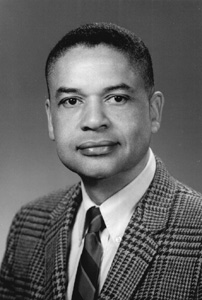
Philip G. Hubbard, April 18, 1968 |
Scope and Contents
The papers of Philip G. Hubbard involve his professional career as educator and administrator at the University of Iowa. While there is some mention of family, the bulk refers to his tenure as professor, and later as Dean of Students. The records span more than 60 years, from 1932 to 1997. Of particular note are the speeches of Professor Hubbard, including his support of fair housing in 1964. The collection also includes drafts and manuscripts of his public memoirs. The collection is reflective of one man's role in the emerging civil rights movement in Iowa City during the 1960s.
Biographical Note
Philip Gamaliel Hubbard was born March 4, 1921, in Macon, Missouri. His mother was a school teacher in Missouri's segregated school system. With her children in mind, she moved her family to Iowa when Philip was four, because schools there were integrated, and she took a job as an elevator operator in Des Moines. Hubbard graduated there in 1939 from North High School where he was active in band, orchestra, chorus, biology club, freshman football, and was on the National Honor Society. By the time of his graduation, he had saved $252.50 for college. As he recalled in his 1999 memoir, “My Iowa Journey: The Life Story of the University of Iowa’s First African American Professor,” this was accomplished by shining shoes for 15 cents per pair at the Hotel Savery. He elected to attend the University of Iowa over Iowa State, because he could shine shoes at the Jefferson Hotel in Iowa City for income. Tuition at Iowa was $50 per semester.
Black men were not allowed to live in University housing. Instead, they found black families they could live with, and in Iowa City that was often along the railroad tracks. Hubbard and his black classmates designed social events for themselves, as they were not allowed to attend University events if a white student complained about their presence. They held casual Sunday evening gatherings, as well as elegant dinner parties, and they pooled their academic strengths as they studied together.
In 1943 after three years of classes, Hubbard enlisted in the Army reserves; the following year he received Army certification in electrical engineering from Pennsylvania State University. Francis M. Dawson, Dean of the College of Engineering at the University of Iowa, arranged for Hubbard's discharge from the army in 1945 so he could conduct war research at the University of Iowa. He graduated with honors June 1, 1947, with a B.S. in Electrical Engineering. That same year, Hubbard became the first black faculty member at the University of Iowa. He held the position of research engineer.
Philip Hubbard continued his education at Iowa, earning an M.A. in mechanics and hydraulics in 1949, and a doctorate in engineering in 1954. In 1951 Hubbard founded Hubbard Instrument Company, a small measurement consulting company, and he invented two instruments for measuring fluid turbulence. By this time Hubbard had a growing family which he wanted to raise in Iowa City. He married Wynonna Griffith of West Des Moines on May 3, 1943, and the couple raised five children.
For twelve years, from 1954 until 1966, Professor Hubbard taught mechanics and hydraulics in the University of Iowa College of Engineering Department. Through Hubbard Instrument Company he served as a consultant to the Army, Navy, and Air force, as well as to General Electric and General Motors. During these years he worked to eliminate housing discrimination that had persisted since his college days more than twenty years earlier. He spoke at Kiwanis luncheons, and elsewhere, urging community business leaders to approve a strengthened fair housing ordinance for Iowa City, which was adopted August 18, 1964.
Hubbard was selected to become Dean of Academic Affairs on January 1, 1966, becoming the first black administrator at any of Iowa's three state universities. In order to accept the appointment, he cancelled a Fulbright lectureship, which would have taken him to the University of Chile at Santiago for the spring and summer semesters. At the time of his appointment he was the College of Engineering faculty representative on the Board in Control of Athletics. As Dean, Hubbard played a major role in keeping the University running during the anti-war protests of the late 1960s and early 1970s. He was never afraid of the angry crowds, and in fact waded into them to communicate.
In 1971 Hubbard was named Vice President of Student Services, making him the highest-ranking minority in Iowa educational circles. He was the first black vice president at a Big Ten university.
In fall 1987, Hubbard and others founded Opportunity at Iowa, a program designed to attract and retain minority students and faculty. The program has its roots in the systematic recruitment that began in 1968.
On December 31, 1990 Philip G. Hubbard retired at the age of 69 after 43 years with the University of Iowa. As a lasting memorial to him, Union Field was renamed Hubbard Park on December 6, 1991. Hubbard died on January 10, 2002 at age 80.
[D. Anderson; 12/2001]
Related Materials
Hubbard, Philip G. "A Constant-temperature Hot-wire Anemometer for Use in Air." State University of Iowa master's thesis, 1949.
Ibid. "Constant-temperature Hot-wire Anemometry with Application to Measurements in Water." State University of Iowa Ph.D. dissertation, 1954.
Ibid. My Iowa Journey. Iowa City: University of Iowa Press, 1999.
Ibid. New Dawns: A 150-Year Look at Human Rights at the University of Iowa. Iowa City: University of Iowa Press, 1996.
Persons, Stow. The University of Iowa in the Twentieth Century: An Institutional History. Iowa City: University of Iowa Press, 1990.
Spriestersbach, D.C. The Way it Was: the University of Iowa, 1964-1989. Iowa City: University of Iowa Press, 1999.
Box Contents List
Box 1
Teaching series
---. Advanced mechanics of fluids, 1956-1961
---. Class list sheets and evaluations, 1956-1965
---. Class lists, 1948/1949-1963/1964
---. Creative design subcommittee, 1966
---. Curriculum committee miscellaneous, 1965-1966
---. Engineering faculty council, 1965
---. Engineering library, 1960
---. Goals committee material, 1965
---. Humanities subcommittee, 1966
---. Long-range plan, 1954
---. Policy and planning, 1959
---. Science subgroup, 1966
---. Teaching of creative thinking, 1956
---. University of Illinois-Chicago catalog, 1965
---. Central administration comments, 1971-1973
---. College review, 1965-1971
---. Dean's comments, 1972
---. Dean search and review report, 1972
---. Engineering education comments, 1972-1973
---. External review, 1972
---. Goals and future plans, 1972
---. Hering memo to Gillis, 1972-1973
---. Lance and Leone memorandum, 1972
---. Letters of response, 1972-1973
---. Review of the College of Engineering, 1972
---. Statistical data, 1972
Box 2
College of Engineering series
---. Reports to President Boyd
---. 1946-1973
---. After 1965
Box 3
Awards, Recognitions, and Accomplishments series
---. Certificate, spelling competition, 1932
---. Certificate, National Honor Society, 1938
---. North High School diploma, 1939
---. Certificate, Kappa Alpha Psi, 1941
---. Certificate, Phi Lambda Upsilon, 1942
---. Certificate, Tau Beta Pi, 1943
---. Certificate, Army specialized training, 1944
---. Certificate, Society of the Sigma Xi, 1947, 1949
---. Certificate, UI graduate with honors, 1947
---. Degree, M.S. in Engineering at UI, 1949
---. Degree, Ph.D. in Philosophy at UI, 1954
---. Certificate, Eta Kappa Nu, 1959
---. Certificate in Latin, College of St. Ambrose, 1969
---. Certificate in English, College of St. Ambrose, 1969
---. Certificate, Air Force Reserve Officer Training, n.d.
---. Certificate, Royal Nepal Airlines, n.d.
---. Awards, NAACP, ca. 1990
---. Certificate, Elderhostel, 1997
---. Recognition, Hubbard Park, 1992
---. Awards, Alumni, 1988-1996
---. Recognition, Correspondence and photos
---. Accomplishments, Civil Rights, 1963-1964
---. Accomplishments, Institute for Learning and Development
---. Accomplishments, Student leaders
---. Accomplishments, Undergraduate scholar assistantships
Box 4
Clippings and Press Releases series
---. The Iowa State Bystander, 1994
---. Iowa City Kiwanis Club, 1967
---. Women and human rights activities
---. Various clippings
---. Press releases, 2 folders
---. Scrapbook
Box 5
Opportunity at Iowa series
---. After 1987
---. Faculty and students
---. Planning
---. Miscellaneous, 2 folders
Box 6
Drafts and Manuscripts series
---. New Dawns, Appendix A, 2 folders
---. New Dawns
---. My Iowa Journey, and editors comments
---. Engineer Gone Astray
---. Guardian Angels, 1997
Box 7
Speeches series
---. Fair Housing Ordinance, 1964
---. Symposium, Ft. Collins, Colorado, 1985
---. PGH speeches
---. Photograph, St. Ambrose College Board of Directors, 1984
---. Academic speeches
---. Commencement speeches
Box 8
Videos series
---. "History of the Hydraulics Laboratory", 1951
---. "Tell Me Your Story", October 25, 1991
---. "Reflections: The Shaping of a University", 1996