The University of Iowa Libraries
Special Collections and University Archives

Special Collections
DON L. HOFSOMMER
From Books at Iowa 48 (April 1988)
Copyright: The University of Iowa
(See the finding aid for the John P. Vander Maas Railroadiana Collection at MsC468)
 There has developed, especially in recent times, a depressing rift between those persons outside the collegiate setting who have strong interests in a particular discipline, and those who have a similarly strong interest but who reside within the hallowed halls of academe. Many define the two simply as amateurs and professionals. For instance, in the field of history, practicing scholars -- that is, professors of history pay little heed to the interests or efforts of amateurs -- that is, history buffs. Never mind that professional historians have been around for a relatively short period of time, that the craft was begun and advanced by amateurs, and that long before a Ph.D. was awarded, there were abundant numbers of thoughtful, caring persons who valued and studied the past and who arranged for the collection and protection of invaluable archival materials. This is not to defend narrow particularism that sometimes flaws the efforts of amateurs. Rather, this is to stress common ground and to celebrate a strong symbiotic relationship that would benefit amateur and professional alike. A case in point is the Vander Maas collection at The University of Iowa Libraries.
The mother of John P. Vander Maas recalled that when her son first saw a railroad train, "he jumped up and down" with delight. In a sense, John Vander Maas never stopped jumping up and down; he developed a lifelong interest in the railroad industry. Moreover, he put together one of the country's most impressive private collections of railroad illustrations as well as source materials.
The origin of the collection derives from John's four-year stint as special agent (railroad policeman) for the Chicago, Burlington & Quincy during World War II. Stationed variously around the system, he convinced janitors and others to save outdated timetables which he immediately turned into "trading bait." Thus when Vander Maas left the CB&Q, he had already begun a collection that would grow as his earning power increased and as friends in the industry -- such as the late John D. Mantor, a telegrapher for the Chicago, Rock Island & Pacific at West Liberty-assisted him.
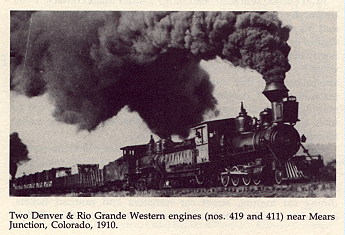 Over the next three decades and more, Vander Maas held diligently to a self-imposed goal-the acquisition of at least 100 items per week. Blessed with good health, adequate income, and a tolerant wife, John saw his holdings burgeon. Two examples adequately illustrate. By 1988, postcard views of streetcars, trains, and other rail scenes exceeded 24,000; the collection of depot photographs was more than 27,000 items.
About a decade ago, Vander Maas began to ponder the ultimate disposition of his materials. There were no children and should he die prematurely, the collection could prove a burden to his wife; but, should he live to a happy retirement, there would be financial and tax considerations. Another variable was more vexing. This entire enterprise, after all, had been a labor of love. Could he part with what had become a great love?
After predictable soul-searching, Vander Maas contacted The University of Iowa, whose representatives properly concluded that his collection was "very unusual" and that an agreement should be worked out to keep it in the Hawkeye state. Lengthy negotiations followed before an agreement was reached whereby units of the collection passed to the University on an annual basis. In that way Vander Maas was able to retain in his possession and continue to expand certain elements while reaping tax credits as portions of the whole were moved to Iowa City. (The agreement specified that all would be transferred in a block in the event of death.)
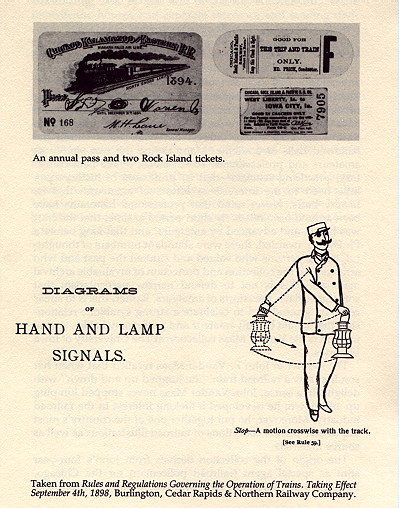
 As a consequence, about half of the entire collection now is on deposit at the University and some of it is cataloged. Included are 140,400 views of locomotives and equipment and 41 boxes of employee and public timetables, train orders, dining car menus, street car transfers and railroad tickets, annual and trip passes, and miscellaneous materials. Still to come are the postcards, depot photographs, business forms, and stock and bond certificates.
Of greatest value to researchers and writers will be the timetables -- a fine representation that offers an impressive glimpse at operations across the entire country -- and the postcards and photographs -- truly a marvelous array that has regional, national, and even international importance. (The University charges a modest processing fee for copying and/or printing photos.)
Individual collections are not categorically complete, of course, and neither is this one. Yet it offers distinctive elements that clearly complement earlier acquisitions such as the Peter Anthony Dey Papers, the Levi 0. Leonard Papers, the Albert N. Harbert collection, and others. More importantly, the Vander Maas collection does much to establish The University of Iowa Libraries as an important repository for archival materials of a transportation nature. This will, in turn, serve as an attraction for even more fine collections.
All of it will redound to the benefit of amateurs and professionals alike. All aboard!
Illustration above is from a New York Central System children's menu.