Collection Guide
This document describes a Manuscript Collection held by the
Special Collections DepartmentUniversity of Iowa Libraries
e-mail: lib-spec@uiowa.edu
Guide Contents
Biographical and Historical Information
Scope and Contents of the Collection
Administrative Information
Access and
Restrictions:
Biographical Note
William Harcourt Hooper, described by St John Hornby as "a very fine craftsman and almost the last of the old school of wood-engravers", worked in the 1850s for the Illustrated News and for such artists as Fred Walker, Du Maurier, Leech and Millais. From 1891 to 1896 he was engaged by the Kelmscott Press and subsequently by the Ashendene and Essex House Presses, where his role was to produce engravings of artists' illustrations, in particular those by Burne-Jones, C.M. Gere and C.R. Ashbee. He worked on the Kelmscott Chaucer, the Essex House Psalter and Ashendene's Mazetto Scelto dei Fioretti di San Francesco, Dante and the Morte d'Arthur.
Scope and
Contents
A collection of proofs of wood-engravings, together with correspondence addressed
to the bookseller James Tregaskis and other related material.Related Materials
Acquisition and Processing Information
These papers
were purchased the
University of Iowa Libraries in
2006.
Guide posted
to Internet:
Proofs of wood engravings
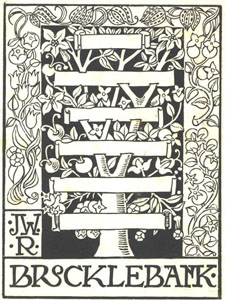
One hundred and three proofs of pictorial initial capitals. Subjects illustrated are principally biblical, although a number depict secular scenes and figures. A few bear the engraver's holograph annotations, and some have been trimmed or have had blank spaces neatly excised; twenty-three proofs of bookplates commissioned by Janet Ashbee, William Abercrombie, C.J. Peacock, the engraver J.B. Swain and others. Proofs of Hooper's design for his own bookplate are also present. With a pen-and-ink design for Ethel Sperry Crocker's bookplate, and a quantity of small book labels for William Morris and Robert Steele (author of the Riccardi Press's Revival of Printing); proofs of six engravings after Gere for the Ashendene San Francesco and after Ashbee for the Essex House Psalter, together with proofs of additional engravings, including signs of the zodiac, kings and queens of England and related subjects; in all some thirty-six pieces. Related ephemera includes a small card on which Hooper has written out the Lord's Prayer within a circle of only one inch diameter, and a series of three proofs by Harry Furniss.
Engravers proofs, bookplates
Engravers proofs, miscellaneous. 2 folders
Correspondence
Seven Autograph Letters (9 1/2 pages small 8vo), one Autograph Note and one Autograph Post Card, all signed. All written from Hammersmith, November 1893 to May 1911. With a 1-1/2 page Autograph Prospectus. All to the London bookseller James Tregaskis.
A few letters are brief, dealing with work accomplished or shortly to be undertaken, making arrangements for a meeting, etc. The more substantial letters tend each to be devoted to a specific topic. They include a poignant description of the funeral of a mutual friend: "The day seemed very suitable, for if it had been bright and cheerful it would have jarred upon me". Another, somewhat bizarre, letter deals with arrangements for a quantity of firearms to be delivered to Tregaskis: "I've made up a parcel for you to try, and am sending ... silver mounted gun in case, Blunderbus, spring bayonet, helmet and visor", &c. Most amusing is a mock prospectus for a parody on the Nuremberg Chronicle to be entitled "The Newhumbug Chronicle": "It will form a most desirable addition to the library ... the rude and clumsy woodcuts of the original being superseded by pictures and photographic reproductions such as are found in the pages of the leading Fine Art newspapers. All the old rubbish is to be thrown aside .. and a grand panorama of the Lord Mayor's Show, several yards long will be a noticeable attraction".
Letters from Hooper to Tregaskis
Other correspondence and ephemera
Included in this category is a touching letter from one of Hooper's domestic staff, Mary Warren (3 pages small 8vo, dated January 1912), telling Tregaskis of the engraver's illness (which proved to be terminal). Also present are two Autograph Notes and one Autograph Post Card, all signed, from the engraver J.B. Swain. Written shortly after Hooper's death they give Tregaskis details of the deceased's estate. Ephemeral items include a short obituary cut from The Athenaeum and a small vellum leaf bearing Latin text and illuminated capital apparently in the late 16th century Italian style, although this cannot be authenticated
Capital, illuminated
Obituary
Other correspondence

