
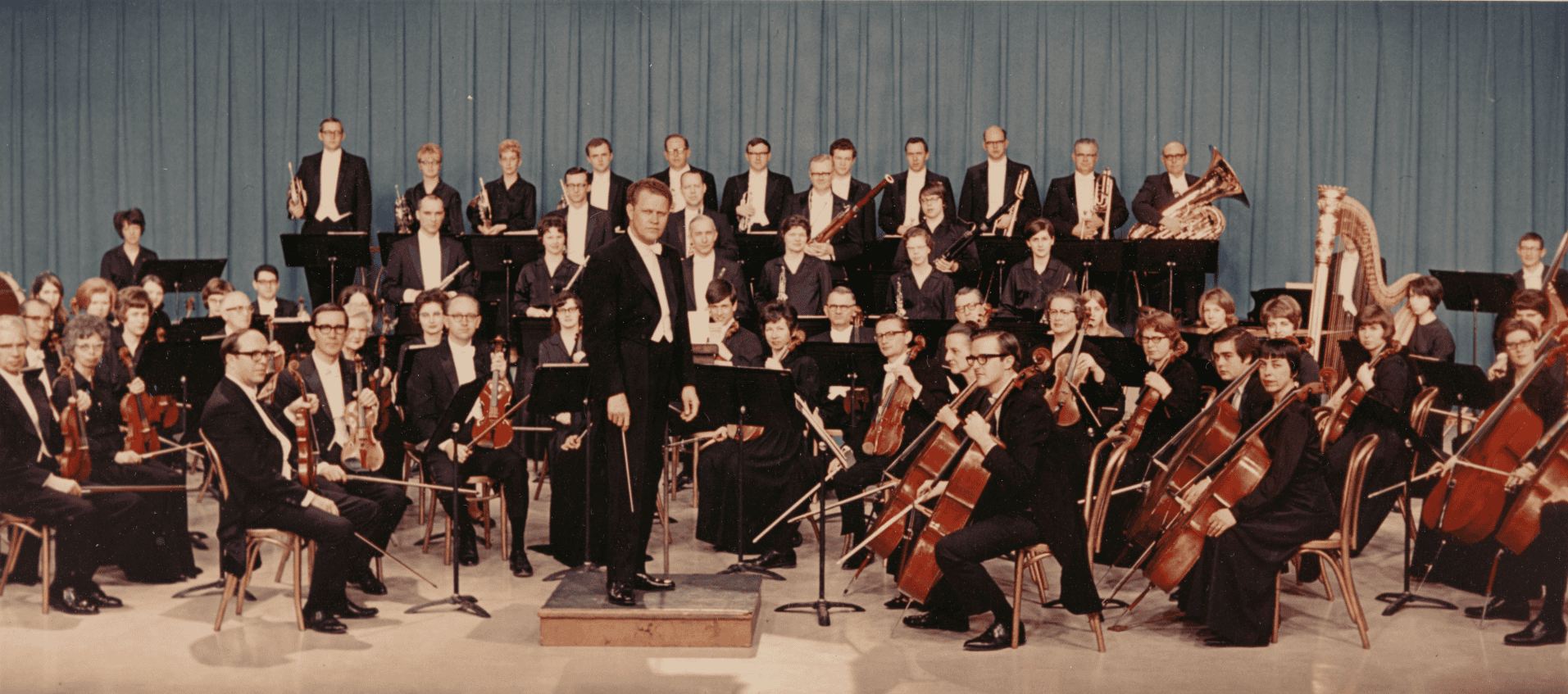
Dixon with the Tri-City (now Quad City) Symphony Orchestra, 1968. James Dixon Papers [UA10028], University Archives, University of Iowa Libraries.
From the exhibition:
“I think it’s something that rarely, if ever, will be seen again in most communities. That kind of dedication and connection to a community…is the sort of relationship that exists very, very, rarely.” – Lance Willett, student of James Dixon and former executive director of the Quad City Symphony Orchestra
An appointment with the Tri-City (now Quad City) Symphony Orchestra (QCSO) made Iowa James Dixon’s home base for the bulk of his professional life. 475 performances over 700 musical works make the conductor the longest-serving music director of the QCSO to date. Through 1,800 trips from Iowa City to Davenport, Iowa and Rock Island, Illinois, Dixon brought performers, audiences, and patrons of the arts from all walks of life closer together.
Based in Davenport, Iowa, the QCSO is one of the oldest continuously operating orchestras in the United States. In 1965, 37-year-old James Dixon was hired as the music director, appointing him steward of this legacy. Budgets, board meetings, and bolstering local pride were all now a part of his work as a conductor. Although Dixon’s programming choices initially tested the tastes of audiences and administrators alike, he quickly garnered a reputation for steady leadership. While learning to work with professional musicians, Dixon also grew into his role in the organization’s ongoing efforts to secure subscribers—members of the community who provide essential annual support. The care Dixon brought to his work combined with his military discipline transformed him into a local celebrity.
In his tenure with the QCSO, Dixon also directed the Youth Symphony, which steadily produced generations of new ensemble performers and concertgoers. The work of the Youth Symphony has also anchored the subsequent development of additional QCSO music education programs, such as “Musicians in the Schools,” which serves over 50,000 students per year.
For his last performances with the orchestra—April 9 and 10, 1994, at the Adler Theater in Davenport, Iowa and Centennial Hall in Rock Island, Illinois—James Dixon selected Symphony No. 5 by Gustav Mahler. Receptions followed both performances. This allowed the larger community to gather one last time and enjoy a meal with the conductor.
As proof Dixon’s influence would outlast his tenure with the orchestra, the president of the QCSO named Dixon the symphony’s first Conductor Laureate, an honorific reflective of his service and success.