
A Guide for Young Listeners to the Des Moines Ballet’s The Nutcracker with the Quad City Symphony Orchestra, 1980s. The workbook explains the roles of the conductor, musicians, and dancers as well as background for the production. On loan from the Quad City Symphony Orchestra.
When James Dixon and the Quad City Symphony Orchestra largely replaced their family concerts series with annual joint productions of The Nutcracker, this grew the reach of a North American tradition first made popular by George Balanchine and the New York City Ballet in 1954. Balanchine’s use of large numbers of children on the stage made a more diverse population of parents, relatives, and friends an expected part of the ballet audience.
Dixon conducted the Quad City Symphony Orchestra from 1965–1994.
Transcription of the above pages:
THE CONDUCTOR
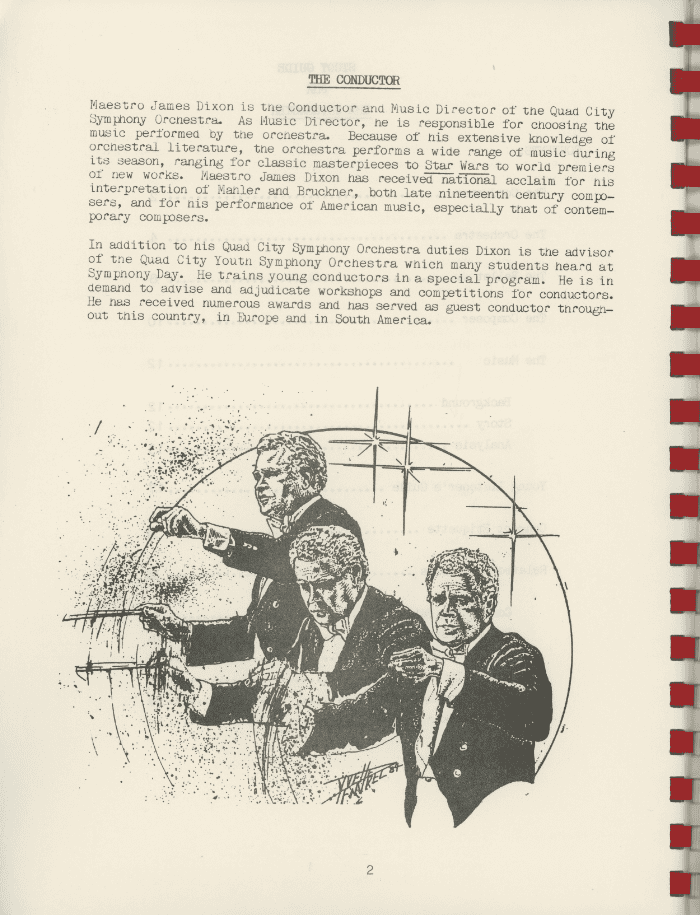
Maestro James Dixon is the Conductor and Music Director of the Quad City Symphony Orchestra. As Music Director, he is responsible for choosing the music performed by the orchestra. Because of his extensive knowledge of orchestral literature, the orchestra performs a wide range of music during its season, ranging [from] classic masterpieces to Star Wars to world premiers of new works. Maestro James Dixon has received national acclaim for his interpretation of Mahler and Bruckner, both late nineteenth century composers, and for his performance of American music, especially that of contemporary composers.
In addition to his Quad City Symphony Orchestra duties Dixon is the advisor of the Quad City Youth Symphony Orchestra which many students heard at Symphony Day. He trains young conductors in a special program. He is in demand to advise and adjudicate workshops and competitions for conductors. He has received numerous awards and has served as guest conductor throughout this country, in Europe and in South America.
What makes a conductor? It is more than standing in front of an orchestra and beating time. It is bringing forth beautiful music from a group of players, inspiring them of excel and training them to become musicians. A fine conductor is first of all a fine musician. He knows the score thoroughly and can convey its meaning to the players through trained hands. He has developed a sense of pitch and knows theory, harmony, music history, and analysis of form. He also has a thorough knowledge of all the instruments.
The technique of conducting is based on gestures made by the hands and baton. The tip of the stick gives the closest definition of the exact instant of the beat. Conductors have not always used the baton. At first, only the hands were used. Later, the leader also played a keyboard instrument and [made] signs now and then to the performers. After a period of thumping the beat on the floor with a long pole, and then a period of silently waving a violin bow, the use of the baton with its precise sign language has been developed.
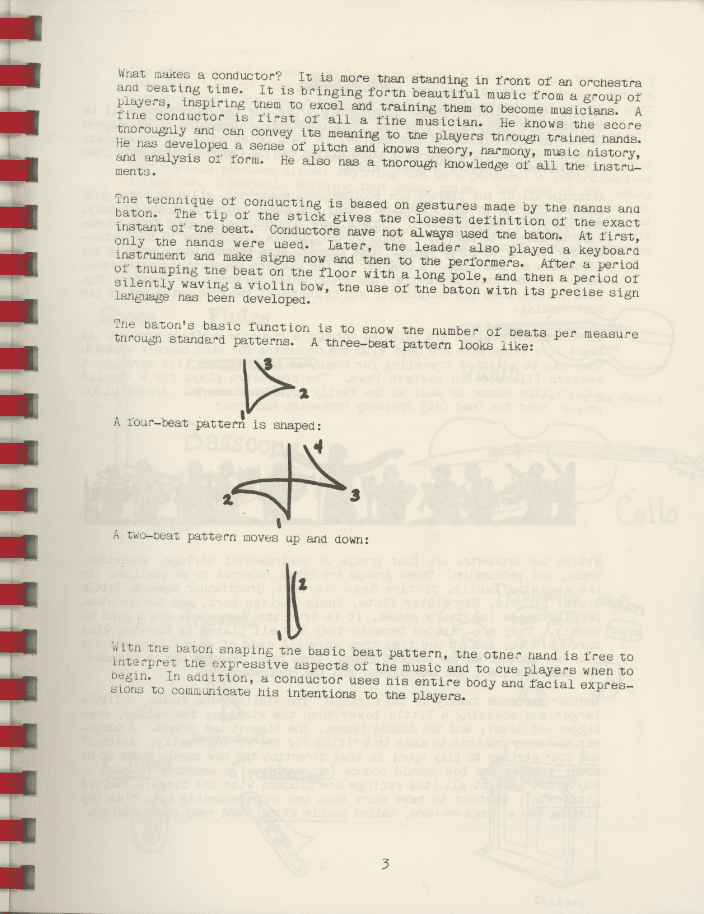
The baton’s basic function is to show the number of beats per measure through standard patterns.
[Page demonstrates three, four, and two-beat patterns through illustration.]
With the baton shaping the basic beat pattern, the other hand is free to interpret the expressive aspects of the music and to cue the players when to begin. In addition, and conductor uses his entire body and facial expressions to communicate his intentions to the players.