
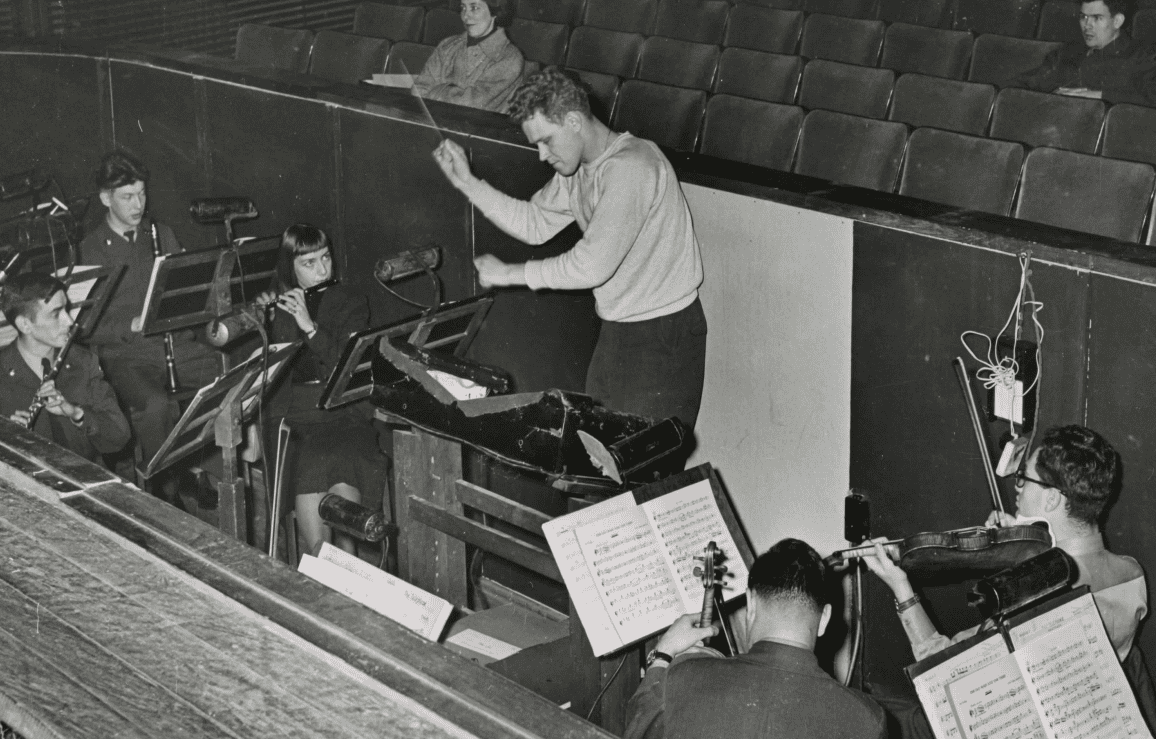
Photograph of James Dixon in the orchestra pit conducting a rehearsal for Menotti’s The Medium and The Telephone, 1955. James Dixon Papers [UA10028], University Archives, University of Iowa Libraries.
After graduating from the University of Iowa in 1952, Dixon joined the U.S. Army as a musician. First, he was assigned to the Navel Academy of Music in Washington, D.C., and the Band School at Fort Riley in Kansas. Then, in March 1953, he was relocated to Stuttgart, Germany, as an assistant conductor for the Seventh Army Symphony. This ensemble of military musicians toured the country’s “Amerika Häuser,” or United States Information Agency German American libraries and cultural centers, “acquainting the German public with a hitherto little-known side of American culture.”
In summer of 1953, Dixon’s music director resigned when faced with the prospect of directing a double program of Gian Carlo Menotti (1911-2007) operas The Old Maid and The Thief and The Telephone. Without any operatic conducting experience of his own, Dixon took over rehearsals and debuted as the newly appointed music director of the Seventh Army Symphony in the Aug. 20–21, 1953, performances of The Old Maid and The Thief andThe Telephone. The U.S. Army reported an average of 500 people in the audience at each tour stop.
Why Menotti operas?
Limited performing forces meant the Seventh Army Symphony could accommodate little more than the 2–5 singers, a dancer/mime, simple sets, and chamber orchestra (14 players) required to perform The Old Maid and The Thief (1939), The Telephone (1946), and The Medium (1945). Variable pairings of these works also offered German audiences dramatic introductions to what was then contemporary American music. Although born in Italy, Menotti is known primarily as an American composer.
German critics praised the “surprising capabilities” of Dixon and his musicians. On the heels of the successful Seventh Army Symphony Tour, the U.S. State Department sponsored an even larger touring production of The Medium and The Telephone in 1955. For his achievements in cultural diplomacy, Dixon was awarded both a Seventh United States Army Certificate of Achievement and the 1954 Elizabeth Sprague Coolidge International Award in conducting—a prize for “the finest young artist of the year.”